In Tagalog, a caterpillar in Tagalog is called higad or uod.
The word higad usually refers to hairy or stinging caterpillars, while uod is a more general term for worm-like larvae. These insects are commonly found on leaves, plants, farms, and trees across the Philippines, where they eventually transform into butterflies (paru-paro) or moths (gamu-gamo).
Understanding caterpillar in Tagalog helps you describe insects and nature more accurately in everyday Filipino conversations.
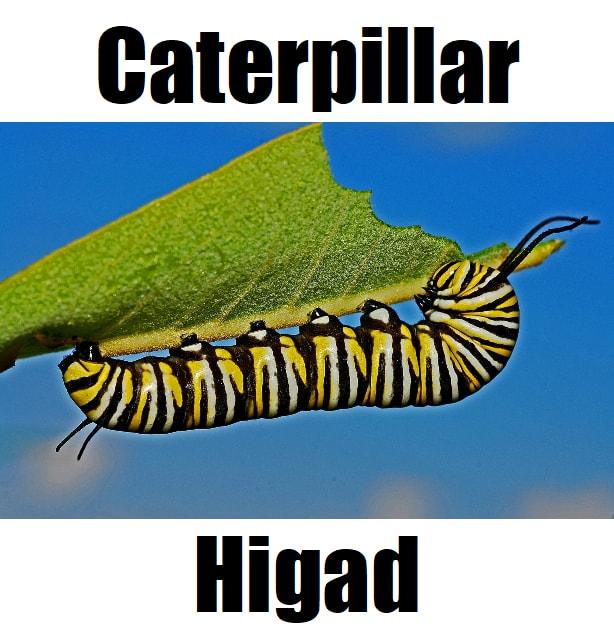
Table of Contents
Caterpillar Vocabulary Words in Tagalog
Here are common Tagalog words connected to caterpillars and their environment:
- Higad / Uod – caterpillar
- Hayop – animal
- Halaman – plant
- Berde – green
- Dahon – leaf
- Insekto – insect
- Paru-paro – butterfly
- Bukid – farm
- Hayop na walang buto – invertebrate
These vocabulary words make it easier to clearly describe a caterpillar in Tagalog, including how it looks, how it behaves, where it lives, and how it changes as it grows. By learning terms like higad, uod, dahon (leaf), and paru-paro (butterfly), you can talk about its feeding habits, natural habitats such as farms and forests, and its complete life cycle—from egg to larva to butterfly or moth. Expanding your vocabulary not only strengthens your Filipino language skills but also helps you better understand the important role caterpillars play in nature and agriculture.
Example Sentences Using Caterpillar in Tagalog
Here are simple practice sentences:
Ang higad ay may tatlong pares ng mga mata.
A caterpillar has three pairs of eyes.
Ang higad ay may mga sihang para sa pagnguya ng mga dahon.
A caterpillar has mandibles for chewing leaves.
Ang higad ay lumalaki habang ito ay kumakain ng maraming dahon.
A caterpillar grows while eating many leaves.
Ang trabaho ng isang higad ay kumain ng maraming dahon.
A caterpillar’s job is to eat a lot of leaves.
Ang mabuhok na higad ay maaaring magbigay sa iyo ng makating pakiramdam.
A hairy caterpillar can cause an itchy feeling.
Practicing these sentences regularly will help you confidently remember that caterpillar in Tagalog can be called higad or uod. By seeing the words used in real examples, you not only improve your vocabulary but also understand how they function in everyday conversation. Over time, this repetition strengthens both your language skills and your ability to describe insects, nature, and life cycles naturally in Filipino.
Kinds of Caterpillar in the Philippines
The Philippines has many species. Some are harmless, while others are itchy or mildly venomous.
Green Caterpillar Philippines
Often found on garden plants and crops. Many will later become butterflies.
Brown Caterpillar Philippines
Common in forested areas and farms. Some blend into tree bark for protection.
Black and Yellow Caterpillar Philippines
These bright colors often warn predators that the caterpillar may be toxic.
Hairy Caterpillar Philippines
Usually refers to higad. Their tiny hairs can cause skin irritation.
Itchy Caterpillar Philippines
Often Tussock Moth larvae. Avoid touching them.
Monarch Caterpillar Philippines
The Monarch caterpillar has black, white, and yellow stripes. It feeds on milkweed and stores plant toxins for protection.
Common Caterpillar Species in the Philippines
Here are notable examples found locally:
Tussock Moth Larvae (Higad)
- Known for itchy, venomous hairs
- Common in rural and forested areas
Lime Swallowtail (Papilio demoleus)
- Found on citrus and calamansi plants
- Common garden species
Atlas Moth Caterpillar (Attacus lorquinii)
- One of the largest in the Philippines
- Can reach up to 11 cm
Autumn Leaf Caterpillar (Doleschallia bisaltide)
- Blends well with leaves
- Found in gardens and forest edges
Sphinx Moth Caterpillars
- Some mimic snakes as defense
Regional Names for Caterpillar
Different Philippine regions use different terms:
- Higad – Tagalog; usually hairy or stinging
- Karindurunot – local dialect term
- Iras – Hiligaynon term
- Antataro – Bicol term for red, itchy caterpillar
- Budu-budo – Ilokano term
Learning these helps deepen your understanding of caterpillar in Tagalog across regions.
9 Fascinating Caterpillar Facts
Caterpillars are incredible biological machines.
1. Super Eaters
Some species increase their body weight up to 10,000 times from hatching to pupation.
2. 4,000 Muscles
They have up to 4,000 muscles (humans have about 600).
3. 12 Tiny Eyes
They have 12 simple eyes called ocelli that detect light and movement.
4. No Lungs
They breathe through small holes called spiracles on their sides.
5. Silk Producers
They produce silk from modified salivary glands to spin cocoons or hang from plants.
6. Sensory Feet
Some can taste with their feet to check if a plant is edible.
7. Defense Mechanisms
Some are poisonous (like Monarch caterpillars). Others have fake eyespots or release smelly liquids.
8. Molting Growth
They shed their skin four to six times as they grow.
9. Metamorphosis Magic
Inside the chrysalis, their bodies break down and reorganize into butterflies or moths.
Safety and Ecology in the Philippines
Understanding caterpillar in Tagalog is useful not only for language learning but also for safety.
Safety Notes
- Avoid touching hairy or brightly colored caterpillars
- Wash skin immediately if exposed
- Some species can cause itching or rashes
Ecological Importance
- Some are agricultural pests (coconut, citrus farms)
- They are major food sources for birds
- They are essential to butterfly and moth life cycles
- They support Philippine biodiversity
Conclusion
Learning the meaning of caterpillar in Tagalog — higad or uod — helps you talk about insects, farms, and nature in Filipino environments. Whether it is a green caterpillar in the Philippines, a brown forest species, a black and yellow warning-colored larva, or a hairy itchy higad, each plays a role in the ecosystem.
Caterpillars may look simple, but they are powerful eating machines, silk producers, and future butterflies. Understanding caterpillar in Tagalog connects language learning with the rich biodiversity of the Philippines.