Shapes are some of the first vocabulary words children learn in school, and they remain useful throughout daily life. In Tagalog, shapes are called mga hugis, and these words are commonly used in classrooms, art activities, signs, math lessons, and everyday descriptions of objects around the home.
Learning shapes in Tagalog helps children describe drawings and objects, while adults can use these words to explain size, design, directions, and appearance. From basic forms like bilog (circle) and tatsulok (triangle) to more complex geometric shapes, these words appear naturally in Filipino conversations.
This guide presents shapes in Tagalog using organized categories, easy-to-read tables, simple example sentences, and practical explanations. Whether you are teaching students, learning Tagalog yourself, or creating educational content, this post will help you use mga hugis confidently and naturally.
Table of Contents
Basic Shapes in Tagalog
(Mga Pangunahing Hugis)
These are the most common shapes taught in preschool and early elementary school in the Philippines. They are used daily in classrooms, worksheets, drawings, and simple object descriptions.
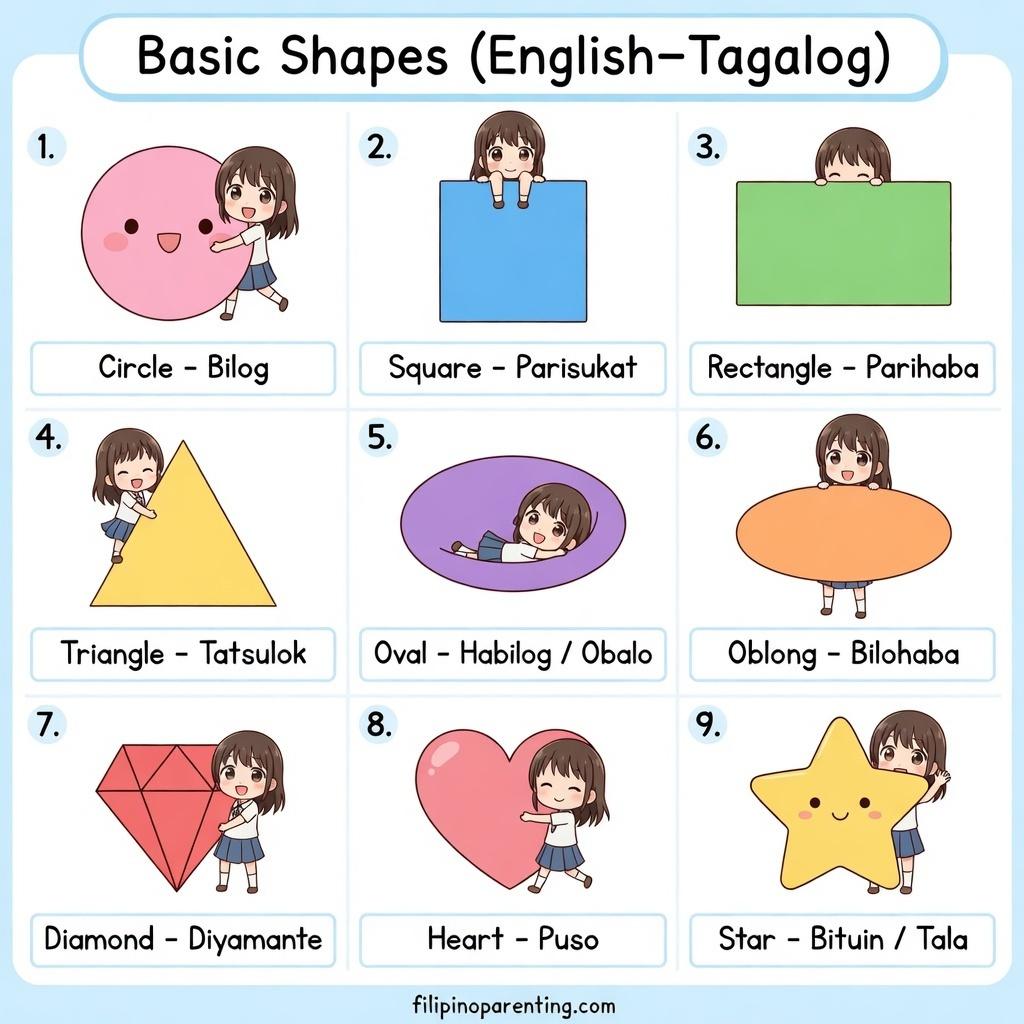
Basic Shapes Vocabulary
| Tagalog | English |
|---|---|
| Bilog | Circle |
| Parisukat | Square |
| Kuwadrado | Square (measurement use) |
| Parihaba | Rectangle |
| Tatsulok | Triangle |
| Habilog / Obalo | Oval |
| Bilohaba | Oblong |
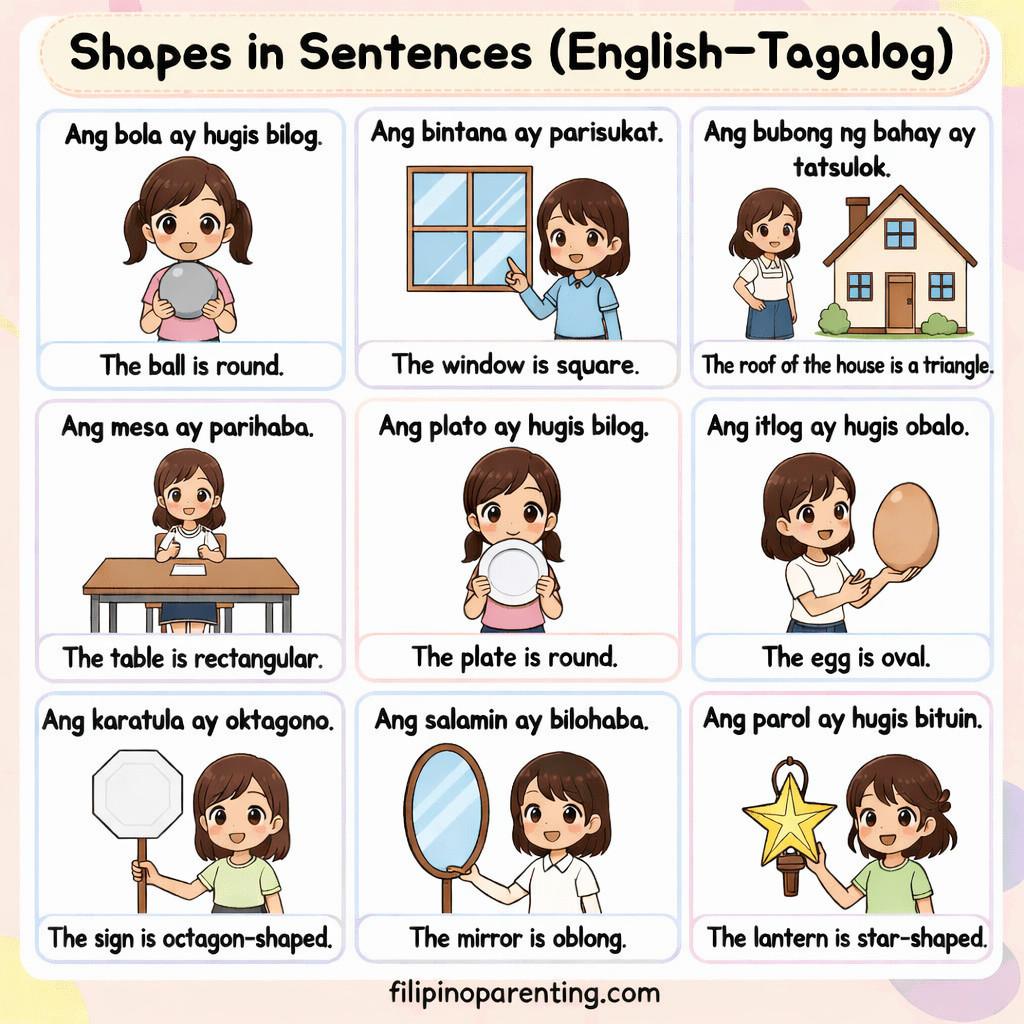
Example Sentences Using Shapes in Tagalog
| Tagalog Sentence | English Translation | Key Shape |
| Ang bola ay hugis bilog. | The ball is round. | Circle |
| Ang bintana ay parisukat. | The window is square. | Square |
| Ang bubong ng bahay ay tatsulok. | The roof of the house is a triangle. | Triangle |
| Ang mesa ay parihaba. | The table is rectangular. | Rectangle |
| Ang plato ay hugis bilog. | The plate is round. | Circle |
These simple sentences show how mga hugis are naturally used in everyday Tagalog. By connecting shapes to familiar objects like a ball, window, table, or house, learning becomes easier and more memorable—especially for students and beginners. Practicing these short sentences helps build confidence, improve sentence structure, and make describing objects in Tagalog feel natural and effortless.
As learners become more comfortable with these basic shapes, they can begin using hugis + object to describe almost anything they see around them, turning everyday surroundings into opportunities for Filipino language learning.
Common Geometric Shapes
(Mga Hugis Heometriko)
These shapes are commonly introduced in math and science lessons. Many of their Tagalog names are adapted from Spanish or English but are widely understood.
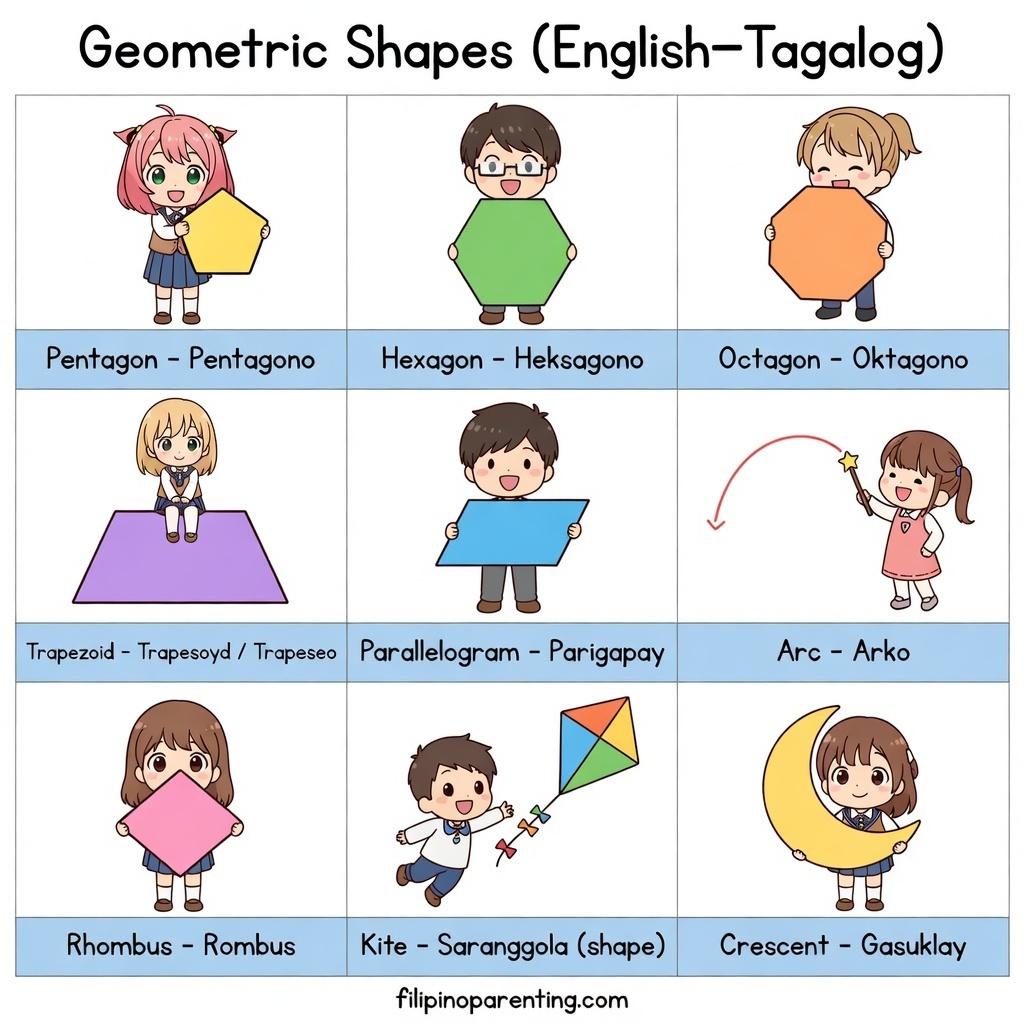
Geometric Shapes Vocabulary
| Tagalog | English |
|---|---|
| Pentagono | Pentagon |
| Heksagono | Hexagon |
| Oktagono | Octagon |
| Trapesoyd / Trapeseo | Trapezoid |
| Parigapay | Parallelogram |
| Arko | Arc |
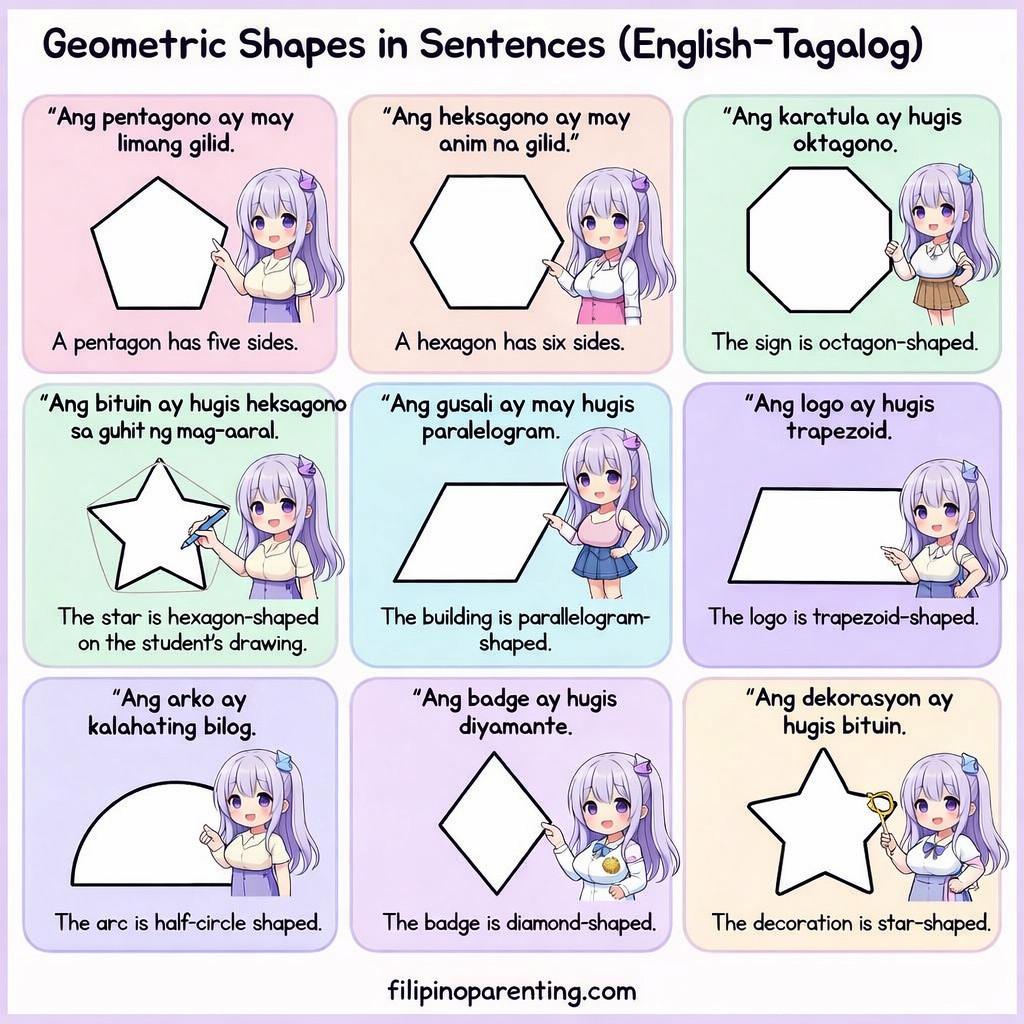
Geometric Shapes in Tagalog: Example Sentences
| Tagalog Sentence | English Translation | Key Shape |
| Ang pentagono ay may limang gilid. | A pentagon has five sides. | Pentagon |
| Ang heksagono ay may anim na gilid. | A hexagon has six sides. | Hexagon |
| Ang karatula ay hugis oktagono. | The sign is octagon-shaped. | Octagon |
| Ang bituin ay hugis heksagono sa guhit ng mag-aaral. | The star is hexagon-shaped in the student’s drawing. | Hexagon |
| Ang gusali ay may hugis parigapay. | The building has a parallelogram shape. | Parallelogram |
These sentences introduce more advanced mga hugis that are commonly taught in school and used in signs, drawings, and basic geometry lessons. Learning how to describe the number of sides and the shape of objects helps learners express ideas more clearly in Tagalog, especially in academic and everyday settings. With continued practice, these shape terms become easier to recognize and use when describing the world around you.
3D Shapes in Tagalog
(Tatlong-Dimensyong Hugis)
Three-dimensional shapes are used in math, architecture, toys, and real-world object descriptions. In everyday conversation, Filipinos often describe these using familiar objects.
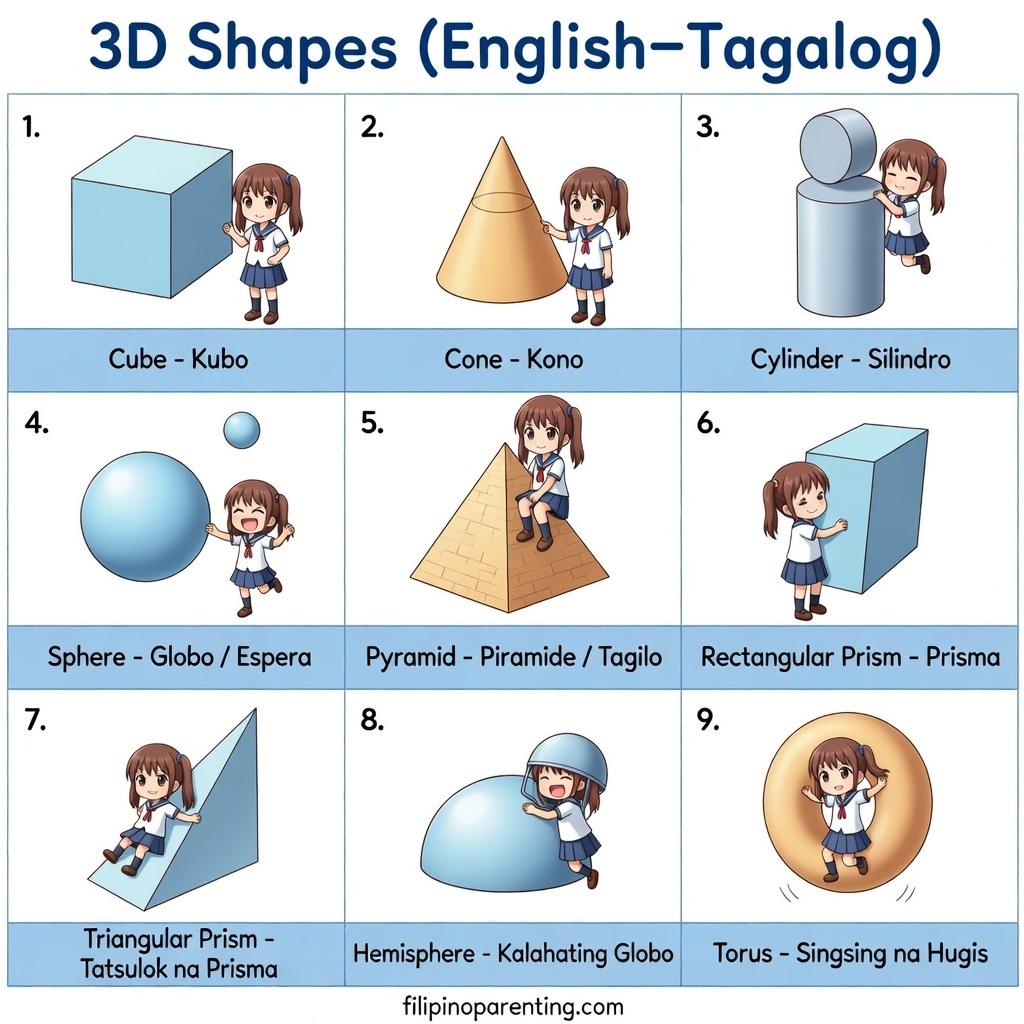
3D Shapes Vocabulary
| Tagalog | English |
|---|---|
| Kubo | Cube |
| Kono | Cone |
| Silindro | Cylinder |
| Globo / Espera | Sphere |
| Piramide / Tagilo | Pyramid |
To maintain the professional and “cozy” aesthetic of your brand while optimizing for shapes in Tagalog, I have organized these 3D examples into a clean, scannable table.
I’ve also ensured the language remains mature and sophisticated, perfect for your adult learners or travelers exploring the architecture of the city.
3D Shapes in Tagalog: Practical Example Sentences
| Tagalog Sentence | English Translation | 3D Shape (Tagalog) |
| Ang dice ay hugis kubo. | The dice is cube-shaped. | Kubo (Cube) |
| Ang ice cream ay nasa kono. | The ice cream is in a cone. | Kono (Cone) |
| Ang bola ay hugis globo. | The ball is spherical. | Globo (Sphere) |
| Ang lata ay hugis silindro. | The can is cylinder-shaped. | Silindro (Cylinder) |
| Ang piramide ay may matulis na tuktok. | The pyramid has a pointed top. | Piramide (Pyramid) |
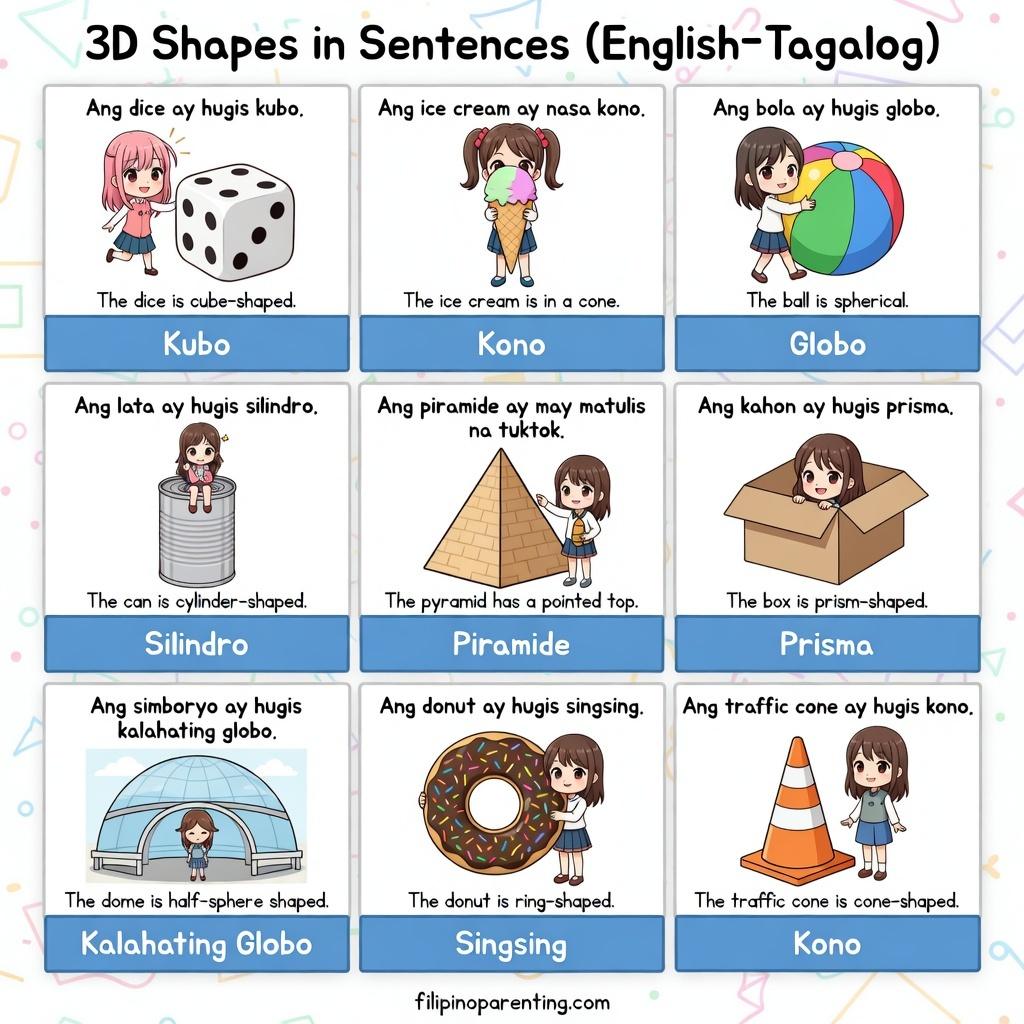
These three-dimensional mga hugis are commonly seen in toys, food, packaging, and everyday objects. Learning these shape words in Tagalog helps learners describe size, form, and structure more clearly. As you practice using these terms in simple sentences, recognizing and describing 3D shapes in Tagalog becomes natural and easy in daily conversation and learning.
Descriptive Shapes Using Hugis + Object
When there is no exact geometric word, Tagalog often uses hugis + object to describe shape. This is very common in daily speech.
Descriptive Shapes Vocabulary
| Tagalog Phrase | English |
|---|---|
| Hugis puso | Heart-shaped |
| Hugis bituin / Hugis tala | Star-shaped |
| Hugis dyamante | Diamond-shaped |
| Hugis buwan | Moon-shaped |
| Hugis gasuklay | Crescent-shaped |
| Hugis krus | Cross-shaped |
| Hugis singsing | Ring-shaped |
| Hugis palaso | Arrow-shaped |
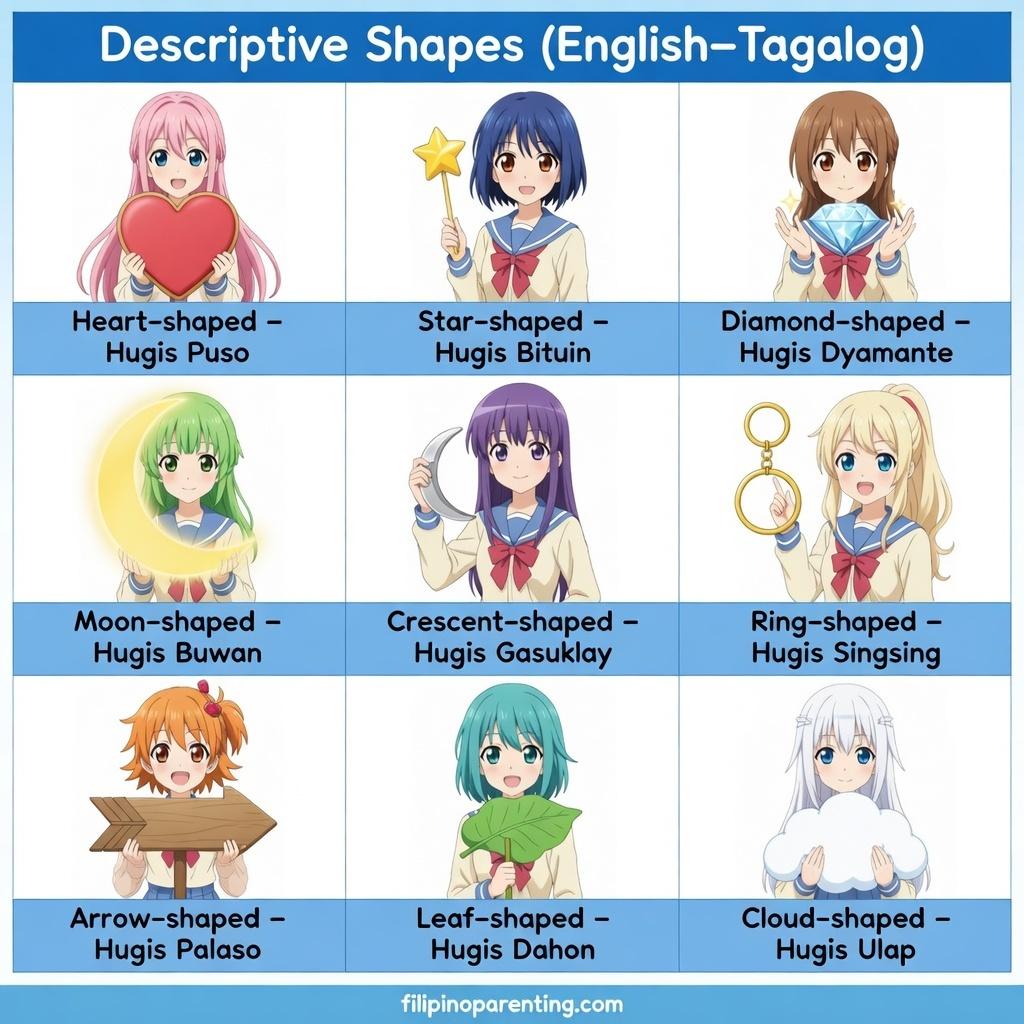
Descriptive Shapes in Tagalog: Example Sentences
| Tagalog Sentence | English Translation | Key Descriptive Shape |
| Gumuhit siya ng hugis puso. | She drew a heart shape. | Heart-shaped |
| Ang parol ay hugis bituin. | The lantern is star-shaped. | Star-shaped |
| Ang buwan ay hugis gasuklay. | The moon is crescent-shaped. | Crescent-shaped |
| Ang dekorasyon ay hugis dyamante. | The decoration is diamond-shaped. | Diamond-shaped |
| Ang simbolo ay hugis krus. | The symbol is cross-shaped. | Cross-shaped |
These descriptive hugis words are commonly used in art, decorations, celebrations, and cultural symbols in the Philippines. Learning shape-based descriptions in Tagalog helps learners express visual details more clearly while connecting language with everyday Filipino life, traditions, and creative expression.
Why Learning Shapes in Tagalog Matters
Shapes in Tagalog appear in:
- Preschool and elementary lessons
- Art and drawing activities
- Math and geometry classes
- Describing objects, buildings, and signs
- Everyday conversation
Because shapes are visual and concrete, they are easy to remember and perfect for building early vocabulary. Learning mga hugis also helps learners form descriptive sentences and understand Filipino explanations more naturally.
Frequently Asked Questions (FAQ)
What is the word for “shape” in Tagalog?
The word for shape in Tagalog is hugis. When referring to more than one shape, the plural form mga hugis is used. Learning this basic term is essential for describing objects, drawings, signs, and everyday items in Filipino.
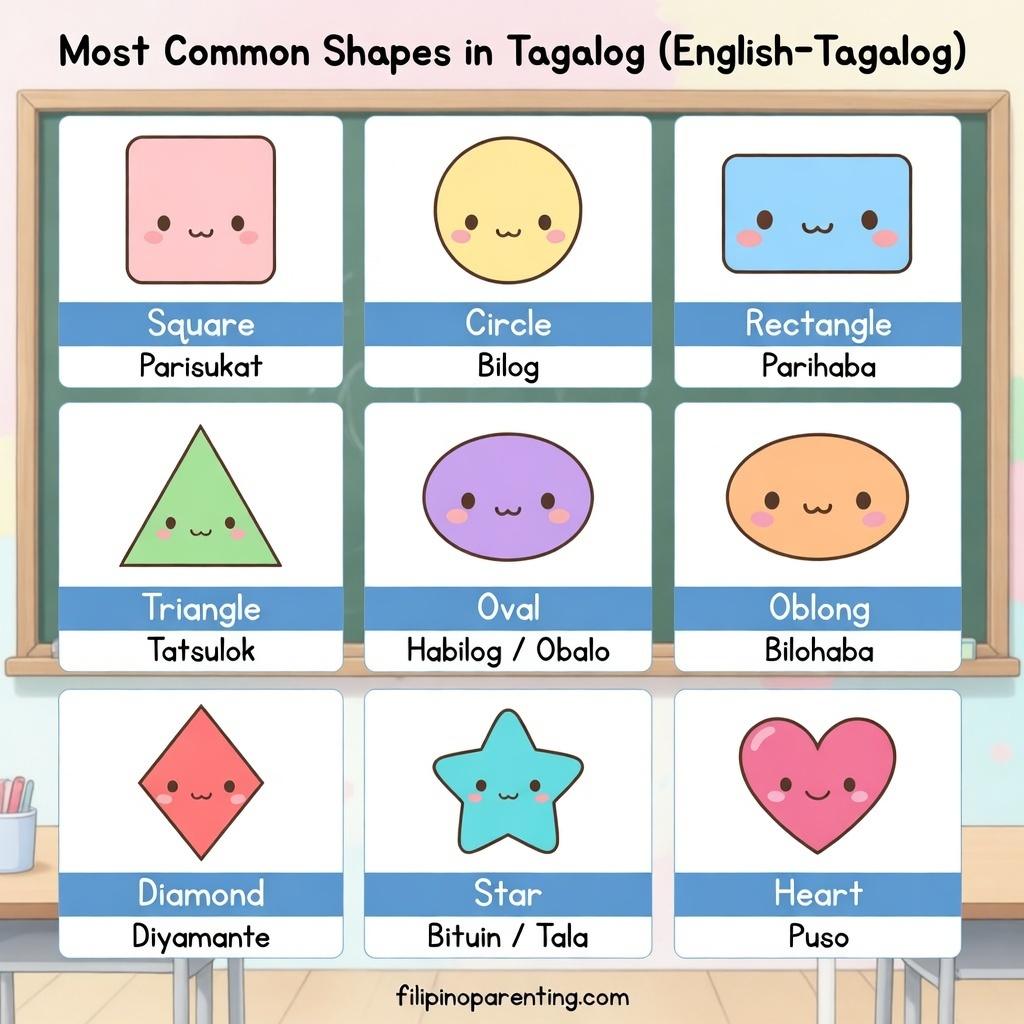
What are the most common shapes in Tagalog?
The most common shapes in Tagalog used in daily conversation include:
- Bilog – Circle
- Parisukat – Square
- Parihaba – Rectangle
- Tatsulok – Triangle
These shapes are taught early in school and are frequently used to describe household items, buildings, and objects around us.
How do you describe unique or unusual shapes in Tagalog?
When there is no specific geometric term, Filipinos commonly use the pattern hugis + object.
Examples include:
- Hugis puso – Heart-shaped
- Hugis bituin – Star-shaped
- Hugis buwan – Moon-shaped
This flexible structure is very natural in Tagalog and is widely used in everyday speech.
Where can I find a complete list of shapes in Tagalog?
A complete list of shapes in Tagalog can be found in structured learning guides, educational textbooks, and Filipino language resources that focus on basic vocabulary and geometry. Practicing these mga hugis through categorized tables, example sentences, and real-life descriptions—like those found in this guide—helps learners retain vocabulary more effectively and use it confidently in conversation.
You can find our comprehensive guide to shapes in Tagalog right here. This article covers everything from basic 2D forms to complex 3D geometric shapes and descriptive terms used in natural Filipino conversation.
Conclusion
Learning shapes in Tagalog connects language with how we observe, describe, and interact with the world. From architectural lines in urban landscapes to the natural curves of nature, mga hugis are everywhere—making them practical, memorable, and essential for any vocabulary.
By organizing these shapes in Tagalog into clear categories with example sentences, learners can naturally build their language skills while understanding how these words are used in real Filipino conversations. Whether you are a student, a traveler, or an educator sharing knowledge with the younger generation, mastering shapes in Tagalog is a simple but powerful step toward fluency.