Learning the Tagalog Months of the Year is more than just memorizing a list—it’s a glimpse into Filipino culture, history, and the unique rhythm of life in the islands. Just as traditional Filipino meals have their own distinct flavors, the buwan ng taon (months of the year) mark the passage of time through vibrant festivals and shifting tropical seasons.
Whether you are tracking your employment tenure in months, planning for the famous “Ber Months” celebrations, or helping the younger generation connect with their heritage, understanding these names is essential. This guide provides a deep dive into the 12 months in Tagalog, complete with pronunciation guides and “Real-Talk” cultural context.
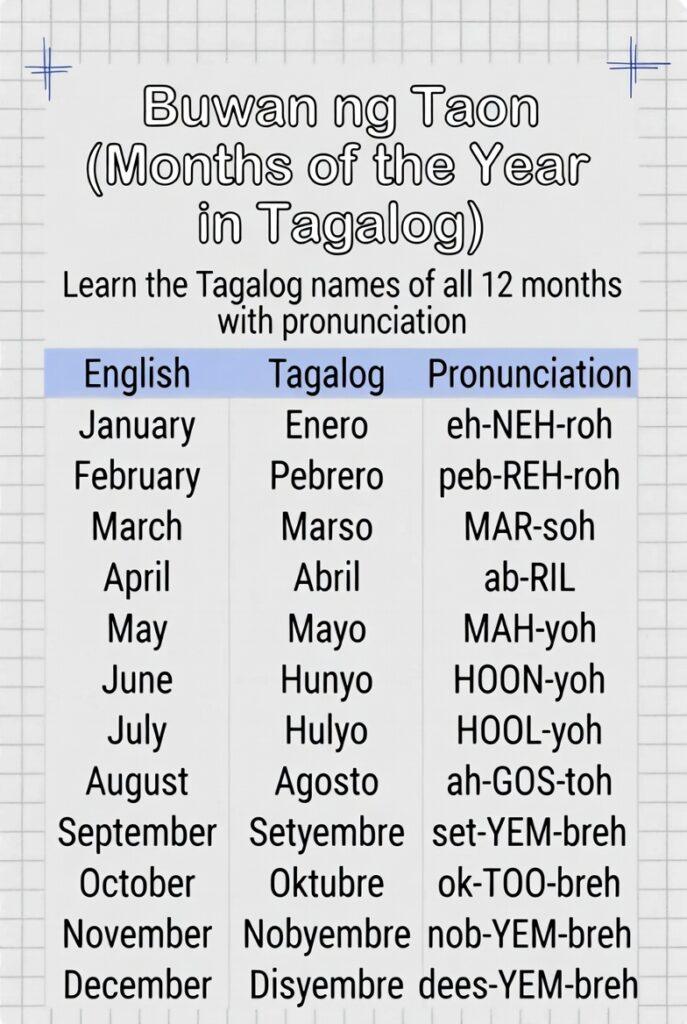
Table of Contents
Why the Tagalog Calendar Matters
- Linguistic Roots: Discover the Spanish influence on our modern month names.
- Cultural Connection: Each month is tied to a specific Fiesta or family tradition.
- Practicality: Essential for discussing travel, Tagalog calendar dates, and official history
The 12 Months in Tagalog (mga Buwan ng Taon)
Mastering these Filipino Month names provides the Tagalog calendar basics you need to speak with “Real-Talk” confidence. Use the table below to learn the correct spelling and the rhythmic pronunciation used by locals.
| English | Tagalog | Pronunciation |
|---|---|---|
| January | Enero | eh-NEH-roh |
| February | Pebrero | peb-REH-roh |
| March | Marso | MAR-soh |
| April | Abril | ab-RIL |
| May | Mayo | MAH-yoh |
| June | Hunyo | HOON-yoh |
| July | Hulyo | HOOL-yoh |
| August | Agosto | ah-GOS-toh |
| September | Setyembre | set-YEM-breh |
| October | Oktubre | ok-TOO-breh |
| November | Nobyembre | nob-YEM-breh |
| December | Disyembre | dees-YEM-breh |
Tip: Just like Filipino meals have their own rhythms, each month carries its own atmosphere, festivals, and special moments.
Understanding the months in Tagalog is a vital step in mastering the language and appreciating the “Real-Talk” flow of Filipino life. By learning these buwan ng taon, you aren’t just checking a box on a Tagalog vocabulary list; you are gaining the tools to discuss everything from historical milestones to future family gatherings. As you move forward, try incorporating these names into your daily schedule or printable worksheets to build muscle memory. Remember, much like a shared family meal, the Filipino year is best enjoyed when you understand the unique story and “panahon” (season) that each month brings to the table.
Seasons and Weather: The “Feel” of the Tagalog Calendar
Even though the Philippines primarily experiences tropical wet and dry seasons, we often use specific terms to describe the weather or the “feel” of certain buwan ng taon. Whether you are planning a trip during the dry months in the Philippines or simply telling stories about the past few months in Tagalog, these words help paint a vivid picture of the atmosphere.
| English | Tagalog | Pronunciation | Typical Months |
| Winter / Cool season | Taglamig | tag-LAH-mig | December – February |
| Spring / Blossoming | Tagsibol | tag-SEE-bol | March – April |
| Summer / Hot season | Tag-init | tag-EE-nit | April – May |
| Autumn / Harvest | Tag-lagas | tag-LAH-gas | September – November |
While the Tagalog calendar doesn’t follow the traditional four-season model found in the West, using these terms allows learners to express the transition from the scorching tag-init to the festive, cooler taglamig. Understanding these shifts is key to navigating everyday Filipino life, much like knowing the right time of day for specific traditional snacks or “merienda.”
Filipino Festivals by Month: A Cultural Calendar
Just as Filipino meals have unique flavors and regional ingredients, each buwan (month) carries its own atmosphere and ancestral traditions. Understanding the festivals in the Philippines by month is the key to unlocking the true “Real-Talk” spirit of the islands. These celebrations—often called Fiestas—bring communities together through shared food, music, and deep-rooted history, making them the perfect way for learners to see the Tagalog calendar in action.
Whether you are planning a trip to the Ati-Atihan in Enero or preparing for the solemnity of Holy Week in Marso, this cultural breakdown helps the younger generation and parents alike understand how time and community are intertwined. Below, we’ve categorized the most significant celebrations by their Tagalog months of the year, providing a glimpse into the year-long story of the Filipino people.
Enero – January (eh-NEH-roh)
Enero marks the vibrant start of the Tagalog calendar. In the Philippines, the first buwan ng taon is synonymous with “The Mother of All Philippine Festivals” and grand religious processions that draw millions of devotees and travelers alike.
- Cultural Spotlight: Aside from celebrating the New Year’s Eve, the Santo Niño Festivals: The month of Enero is dominated by two of the biggest festivals in the Philippines by month: the Ati-Atihan Festival in Kalibo, Aklan, and the Sinulog Festival in Cebu City. These celebrations feature mesmerizing street dancing, rhythmic drum beats, and participants in intricate tribal costumes, all honoring the Holy Child (Santo Niño).
- Real-Talk Tip for Learners: While the Western world is winding down after the holidays, Filipinos are just getting started! If you are planning a trip in Enero, expect high energy, loud music, and a lot of “Viva Pit Señor!”
- Example Sentence:
- Tagalog: “Ang Ati-Atihan Festival ay ginaganap tuwing Enero sa Kalibo.”
- English: “The Ati-Atihan Festival is held every January in Kalibo.”
Pebrero – February (peb-REH-roh)
Pebrero is often called the “Month of Love” in the Philippines, but it is also a season of blooming beauty. As the taglamig (cool season) begins to fade, the Tagalog calendar shifts its focus to the highlands and the heart.
- Cultural Spotlight: The Panagbenga Festival One of the most anticipated festivals in the Philippines by month is the Panagbenga Festival in Baguio City. The term Panagbenga comes from a Kankanaey term meaning “a season of blooming.” This “Flower Festival” features massive floats made entirely of real blooms and street dancers dressed in flower-inspired costumes, celebrating the city’s recovery from the 1990 earthquake.
- Real-Talk Tip for Parents: In the Philippines, Araw ng mga Puso (Valentine’s Day) is a massive nationwide event. It’s not just for couples; it’s a day for families and friends to show appreciation. If you’re in a major city like Manila during Pebrero, be prepared for heavy traffic and fully booked restaurants—Filipinos take their “Love Month” celebrations very seriously!
- Example Sentence:
- Tagalog: “Maraming tao ang bumibisita sa Panagbenga Festival tuwing Pebrero.”
- English: “Many people visit the Panagbenga Festival every February.”
Marso – March (MAR-soh)
As the heat of the Philippine sun begins to intensify, Marso marks the official entry into the dry season. In the Tagalog calendar, this month is a time of transition—balancing the solemnity of religious preparation with the rustic celebration of the country’s agricultural roots.
- Cultural Spotlight: The Carabao Festival & Mahal na Araw – A standout among festivals in the Philippines by month is the Carabao Festival in Nueva Ecija. This unique event honors the hardworking water buffalo, the national animal of the Philippines. Farmers shave, decorate, and even train their carabaos to kneel in front of the church as a sign of thanksgiving. Additionally, Marso often sees the beginning of Mahal na Araw (Holy Week) preparations, where towns organize massive processions and religious reenactments that have been passed down for centuries.
- Real-Talk Tip for Learners: Marso is typically considered the “Graduation Month” in the Philippines. You will often hear the playful phrase Martsa sa Marso (“March in March”), highlighting the season of academic milestones. It is a time of pride for parents, marked by handaan (feasts) and family gatherings to celebrate the achievements of the younger generation.
- Example Sentence:
- Tagalog: Ang Carabao Festival ay isa sa mga makukulay na pagdiriwang tuwing Marso.
- English: The Carabao Festival is one of the colorful celebrations in March.
Abril – April (ab-RIL)
Abril is the heart of the Philippine summer. In the Tagalog calendar, this month is defined by the scorching heat of tag-init and two major national observances that blend historic bravery with deep spiritual devotion.
- Cultural Spotlight: Araw ng Kagitingan & Semana Santa One of the most significant national holidays in the buwan ng taon is Araw ng Kagitingan (Day of Valor) on April 9th. This day honors the Filipino and American soldiers who fought during World War II, specifically the Fall of Bataan. Simultaneously, Abril is often when Semana Santa (Holy Week) takes place. During this time, the entire country slows down for religious processions, the Visita Iglesia (visiting seven churches), and the Pabasa (the chanting of the Passion of Christ).
- Real-Talk Tip for Travelers: If you are planning to travel during Abril, be aware that the Philippines practically shuts down from Maundy Thursday to Black Saturday. Public transport is limited, and most malls are closed. It’s a time for parents and learners to reflect and spend quiet time with the family, often retreating to the provinces for a cooler breeze.
- Example Sentence:
- Tagalog: Maraming lugar sa Pilipinas ang may prusisyon tuwing Abril para sa Mahal na Araw.
- English: Many places in the Philippines have processions in April for Holy Week.
Mayo – May (MAH-yoh)
Mayo is widely considered the “Month of Festivals” in the Philippines. As the peak of the dry season, the Tagalog calendar explodes with color, flowers, and community gatherings that define the quintessential Filipino summer.
- Cultural Spotlight: Flores de Mayo & Santacruzan The most iconic of all festivals in the Philippines by month is the Flores de Mayo (Flowers of May). This month-long devotion to the Virgin Mary culminates in the Santacruzan, a religious-historical beauty pageant and street procession. Young women representing various biblical and historical figures—most notably Reyna Elena—parade under flower-adorned arches. It is a time when parents and families gather in the town plaza to witness one of the country’s most beautiful traditions.
- Real-Talk Tip for Workers: The month kicks off with Araw ng Paggawa (Labor Day) on May 1st. In the Philippines, this is a major national holiday honoring the hard work of the Filipino labor force. It is common for adult learners and professionals to enjoy a long weekend, often heading to the beach for a final summer “getaway” before the rainy season begins.
- Example Sentence:
- Tagalog: Tuwing Mayo, ipinagdiriwang ang Flores de Mayo sa maraming bayan.
- English: Every May, the Flores de Mayo is celebrated in many towns.
Hunyo – June (HOON-yoh)
Hunyo is a month of immense national pride and historical reflection. In the Tagalog calendar, this month marks the transition from the scorching summer heat to the arrival of the first monsoon rains, but the spirit of celebration remains high across the archipelago.
- Cultural Spotlight: Araw ng Kalayaan (Independence Day) The most significant event in the buwan ng taon is Araw ng Kalayaan on June 12th. This national holiday commemorates the Philippines’ declaration of independence from Spanish colonial rule in 1898. You will see the Philippine flag proudly displayed in homes, government buildings, and parks. Grand parades and the symbolic raising of the flag are held nationwide, particularly at the Aguinaldo Shrine in Kawit, Cavite, and Rizal Park in Manila.
- Real-Talk Tip for Parents: Hunyo is traditionally the start of the “Back-to-School” season in the Philippines (though some schedules have shifted recently). For parents, this month is a busy time of preparing the younger generation for their studies. It is also the month for the Parada ng mga Lechon in Balayan, Batangas (June 24)—a fun, quirky festival where roasted pigs are dressed in costumes and paraded through the streets!
- Example Sentence:
- Tagalog: Ipinagdiriwang ng Pilipinas ang Araw ng Kalayaan tuwing Hunyo 12.
- English: The Philippines celebrates Independence Day on June 12.
Hulyo – July (HOOL-yoh)
As the rains begin to cool the archipelago, Hulyo stands as a month of diplomacy and historical milestones. In the Tagalog calendar, this month is famous for celebrating early alliances and the diverse indigenous roots of the Filipino people.
- Cultural Spotlight: The Sandugo Festival The most iconic of all festivals in the Philippines by month during July is the Sandugo Festival in Bohol. Sandugo literally means “one blood.” This event commemorates the 1565 blood compact between the Spanish explorer Miguel López de Legazpi and Datu Sikatuna, the chieftain of Bohol. It is a powerful symbol of the first treaty of friendship between Filipinos and Spaniards, celebrated today with street dancing, historical reenactments, and the “Miss Bohol Sandugo” pageant.
- Real-Talk Tip for Travelers: While Hulyo marks the peak of the rainy season, it is the perfect time for learners to visit the southern islands where the weather is often more stable. You will also notice Kadayawan sa Davao preparations beginning late in the month. If you are tracking your employment tenure in months, July often serves as the mid-year point—a common time for performance reviews and “mid-year bonuses” in many Filipino companies!
- Example Sentence:
- Tagalog: Ang Sandugo Festival ay ginaganap tuwing Hulyo sa Bohol.
- English: The Sandugo Festival is held every July in Bohol.
Agosto – August (ah-GOS-toh)
Agosto is a month of deep national identity and abundance. In the Tagalog calendar, this is officially celebrated as Buwan ng Wika (National Language Month), making it the most important time for learners to practice their Filipino skills. It is also the month when the southern Philippines takes center stage with world-class cultural festivities.
- Cultural Spotlight: Kadayawan Festival & Buwan ng Wika One of the most spectacular festivals in the Philippines by month is the Kadayawan Festival in Davao City. Derived from the Mandaya word madayaw (meaning good, valuable, or superior), this “King of Festivals” is a celebration of life, a thanksgiving for the gifts of nature, and a tribute to the 11 indigenous tribes of Davao. Simultaneously, schools and government offices nationwide celebrate Buwan ng Wika with traditional costume contests, balagtasan (poetic debates), and essay-writing competitions to honor the national language.
- Real-Talk Tip for Parents: Agosto is a patriotic month for the younger generation. Besides the language celebrations, we observe Ninoy Aquino Day (August 21) and National Heroes Day (last Monday of August). It is the perfect time for parents to teach their family about the brave men and women who shaped the country’s history.
- Example Sentence:
- Tagalog: Makulay at masigla ang Kadayawan Festival tuwing Agosto sa Davao.
- English: The Kadayawan Festival is colorful and lively every August in Davao.
Setyembre – September (set-YEM-breh)
In the Philippines, Setyembre is a cultural powerhouse. In the Tagalog calendar, this month marks the unofficial start of the world’s longest Christmas season—the legendary “Ber Months.” While the air begins to change, the focus shifts to deep spiritual devotion and the preservation of the arts.
- Cultural Spotlight: Peñafrancia Festival & The “Ber Months” The standout among festivals in the Philippines by month during September is the Peñafrancia Festival in Naga City, Bicol. Millions of devotees (called voyadores) gather for a massive fluvial procession along the Naga River to honor “Ina,” Our Lady of Peñafrancia. Beyond Bicol, Setyembre is also the National Month of Culture and Arts, where museums and theaters across the regions showcase the rich diversity of the Filipino spirit.
- Real-Talk Tip for Families: Don’t be surprised if you hear Jose Mari Chan songs playing in the malls on September 1st! For parents, Setyembre is the “warning bell” to start planning for Noche Buena. If you are calculating employment tenure in months, reaching September often means you are eligible for the first half of the traditional “13th-month pay” in some companies—a perfect time to start holiday shopping!
- Example Sentence:
- Tagalog: Ang Peñafrancia Festival ay ginaganap tuwing Setyembre sa Naga City.
- English: The Peñafrancia Festival is held every September in Naga City.
Oktubre – October (ok-TOO-breh)
As the “Ber Months” hit their stride, Oktubre becomes a month of visual wonder and delicious harvests. In the Tagalog calendar, this is the time when the Filipino spirit of Pasasalamat (thanksgiving) is displayed in the most artistic and edible ways possible.
- Cultural Spotlight: The Pahiyas Festival & Lanzones Festival One of the most visually stunning festivals in the Philippines by month is the Pahiyas Festival in Lucban, Quezon. Historically celebrated in May, regional shifts and local observances often highlight these vibrant decorations in October as well. Families decorate their homes with Kiping (colorful leaf-shaped rice wafers), fruits, and vegetables. Simultaneously, in the south, the Lanzones Festival on Camiguin Island celebrates the harvest of the sweet lanzones fruit, featuring street dancing and booths overflowing with local produce.
- Real-Talk Tip for Parents: Oktubre is the perfect time for families to explore the “Harvest Culture” of the Philippines. For parents, it’s a great month to introduce the younger generation to traditional Filipino snacks made from seasonal harvests. Whether you are enjoying fresh lanzones or learning about the intricate process of making Kiping, this month is all about appreciating the bounty of the land.
- Example Sentence:
- Tagalog: Makukulay ang Pahiyas Festival tuwing Oktubre sa Lucban.
- English: The Pahiyas Festival is colorful every October in Lucban.
Nobyembre – November (nob-YEM-breh)
Nobyembre is a month defined by deep family roots and revolutionary courage. In the Tagalog calendar, this is a time for both quiet remembrance and loud national pride, as Filipinos honor those who came before them and those who fought for the nation’s freedom.
- Cultural Spotlight: Undás & Bonifacio Day: The most significant observance in the buwan ng taon is Undás, which encompasses All Saints’ Day (Nov 1) and All Souls’ Day (Nov 2). This is a time when families across the Philippines gather at cemeteries to clean graves, light candles, and share meals in honor of departed loved ones. It is a beautiful, festive atmosphere of remembrance rather than sadness. Later in the month, we celebrate Araw ni Andres Bonifacio (Nov 30), honoring the “Father of the Philippine Revolution” who led the Katipunan against colonial rule.
- Real-Talk Tip for Parents: Undás is one of the biggest “travel seasons” in the country. For parents, this is the time to teach the younger generation about their ancestors. Be warned: the traffic during the first few days of Nobyembre is legendary! It is also the perfect time to start final preparations for the Christmas feast, as the “Ber Months” energy reaches a fever pitch.
- Example Sentence:
- Tagalog: Naglilinis ang mga pamilya ng puntod tuwing Nobyembre para sa Undas.
- English: Families clean graves every November for Undas.
Disyembre – December (dees-YEM-breh)
Disyembre is the grand finale of the Tagalog calendar and arguably the most beloved month in the Philippines. As the peak of the “Ber Months,” the entire country transforms into a vibrant display of lights, music, and the unmistakable spirit of Bayanihan (community spirit).
- Cultural Spotlight: Pasko, Simbang Gabi, and Noche Buena – The most anticipated event in the buwan ng taon is Pasko (Christmas), which officially intensifies on December 16th with the start of Simbang Gabi. These nine dawn masses are a cherished tradition leading up to the main event.
On Bisperas ng Pasko (Christmas Eve), families gather for Noche Buena, a lavish midnight feast featuring staples like Hamón, Quezo de Bola, and Puto Bumbóng. The month concludes with the solemn observance of Rizal Day (Dec 30), honoring our national hero, José Rizal.
- Real-Talk Tip for Parents: For parents, Disyembre is the busiest month for Ninongs and Ninangs (godparents). It is traditional for learners and the younger generation to visit their elders to receive Aginaldo (Christmas gifts or money).
If you are tracking your employment tenure in months, remember that the “13th-month pay” is mandated by law in the Philippines. This extra budget helps families fund their generous holiday feasts and travel expenses during the peak of the season.
- Example Sentence: Tagalog: Tuwing Disyembre, nagdiriwang ang mga pamilya ng Pasko at Noche Buena. English: Every December, families celebrate Christmas and Noche Buena.
Using Months in Everyday Filipino: Conversation & Routines
In the Philippines, the buwan ng taon (months of the year) appear naturally in daily conversations, much like discussing a shared family meal or a daily routine. Whether you are discussing your employment tenure in months or planning a weekend getaway, these Tagalog calendar phrases will help you sound like a local.
Common Example Sentences:
- Enero: Ang Enero ay simula ng bagong taon. (January is the start of the new year.)
- Pebrero: Sa Pebrero, ipinagdiriwang ang Araw ng mga Puso. (In February, Valentine’s Day is celebrated.)
- Pebrero (Events): Ang Panagbenga Festival ay ginaganap tuwing Pebrero sa Baguio. (The Panagbenga Festival takes place every February in Baguio.)
- Hulyo: Babalik kami sa Davao sa Hulyo para sa Kadayawan Festival. (We will return to Davao in July for the Kadayawan Festival.)
- Disyembre: Ang Disyembre ay puno ng Pasko at kasiyahan. (December is full of Christmas and festivities.)
Real-Talk Fun Tip: Just like Filipinos lay out a full Boodle Fight so everyone can enjoy the meal at once, when we talk about the months in Tagalog, we often mention all the activities in one go! Instead of just saying “It’s December,” a Filipino might say, “Disyembre na, Simbang Gabi na, at malapit na ang Noche Buena!” This gives a full, vivid picture of the season.
Quick Vocabulary: Essential Time Words in Filipino
Memorizing the buwan ng taon is only the first step. To talk about your employment tenure in months, describe your daily routine, or discuss upcoming events, these foundational time-telling words are essential. Mastering them allows learners to express themselves with “Real-Talk” fluency.
| English | Tagalog | Pronunciation |
|---|---|---|
| Year | Taon | tah-OHN |
| Month | Buwan | boo-WAHN |
| Week | Linggo | leeng-GOH |
| Day | Araw | ah-RAO |
| Calendar | Kalendaryo | kah-len-DAR-yoh |
| Season | Panahon | pah-nah-HOHN |
| This month | Ngayong buwan | ngah-YONG boo-WAHN |
| Last month | Noong nakaraang buwan | NOOH-ong nah-kah-RAH-ang boo-WAHN |
| Next month | Sa susunod na buwan | sah soo-SOO-nod nah boo-WAHN |
Pro Tip:
- When discussing work or school schedules, combine these words with the buwan ng taon for clarity. Example:
- Ngayong buwan, tatapusin ko ang proyekto. – This month, I will finish the project.
- Noong nakaraang buwan, nagbakasyon kami sa Baguio. – Last month, we went on vacation in Baguio.
- Sa susunod na buwan, magsisimula ang bagong klase. – Next month, the new class will start.
Frequently Asked Questions (FAQ)
What is the Tagalog word for month?
The Tagalog word for month is buwan. This word also means “moon,” reflecting how ancient Filipinos tracked time by the lunar cycle.
How do you say “months of the year” in Tagalog?
The phrase is “mga buwan ng taon.” “Mga” makes it plural, “buwan” means months, and “ng taon” means of the year.
Why do Tagalog months sound like Spanish?
Because the Philippines was under Spanish rule for over 300 years, the Tagalog calendar adopted Spanish names (e.g., Enero from Enero, Marso from Marzo), though the spelling was localized to fit the Filipino alphabet.
What are the “Ber Months” in the Philippines?
The “Ber Months” refer to September (Setyembre), October (Oktubre), November (Nobyembre), and December (Disyembre). In Filipino culture, this marks the official start of the Christmas season.
Closing Thoughts: The Rhythm of the Filipino Year
Knowing the Tagalog months of the year isn’t just about language—it’s about culture, rhythm, and the stories we tell. Much like a traditional Filipino meal brings family and friends together, the months bring communities together through shared festivals, religious holidays, and historical milestones.
As you learn each buwan, think of it as stepping into a story that unfolds all year long. Whether you are a parent teaching the younger generation or an adult learner connecting with your roots, these words are your gateway to the heart of the Philippines.
📥 Free Cultural Resource for Families
Step into the rhythm of the Filipino year! Learn all 12 buwan ng taon with our easy-to-read PDF chart, complete with pronunciations and cultural highlights.
[Download the Free Tagalog Months of the Year PDF Chart] and start exploring the Filipino calendar today!