In the Philippines, daily life moves with rhythm and warmth — much like the steady flow of mga sasakyan along the kalsada at dawn. As the sun rises, the streets slowly fill with kotse, dyip, bus, pedicab, and traysikel, each carrying stories, responsibilities, and quiet hopes for the day ahead. The soft rumble of a motorsiklo, the distant horn of a bus, and the metallic echo of a passing tren become part of the country’s morning soundtrack.
Life begins early. Students prepare for school and wait for their ride. Office workers line up at terminals. Vendors travel to markets. Drivers call out destinations. In busy cities and small towns alike, transportation is already in motion before the day fully unfolds.
Transportation in the Philippines is not just about movement — it is about connection.
When learning vehicles in Tagalog, two important words stand out:
Sasakyan – vehicle
Transportasyon – transportation system
While transportasyon sounds more formal and is often used in official or academic contexts, Filipinos naturally say sasakyan in everyday conversation. “Anong sasakyan mo?” (What vehicle are you taking?) is a common question heard across neighborhoods and terminals.
Because the Philippines is an archipelago of over 7,000 islands, mobility is essential. The sturdy barko connects provinces separated by sea. The bangka supports fishing communities and island travel. The eroplano shortens long distances between regions. On land, jeepneys, buses, tricycles, and bicycles form the backbone of local commuting. In rural areas, even a simple pedicab or motorcycle becomes a lifeline to nearby towns.
Each type of vehicle serves a purpose. Public utility vehicles help workers reach their jobs. Emergency vehicles like the ambulansya and trak na pamatay-sunog protect communities. Heavy equipment such as backhoe and dump truck are there to shape the nation’s infrastructure. From narrow barangay roads to major highways, transportation reflects both resourcefulness and resilience.
Jeepneys are rarely quiet; conversations spark between passengers. Tricycles carry neighbors heading in the same direction. Even waiting at a terminal becomes a shared experience under the tropical heat. Travel in the Philippines often feels communal — people adjust, make space, and move together.
In the Philippines, vehicles are more than machines. They carry families, ambitions, responsibilities, and everyday dreams. Learning the vocabulary of sasakyan is not just about expanding language skills — it is about understanding how Filipinos live, connect, and move forward together.
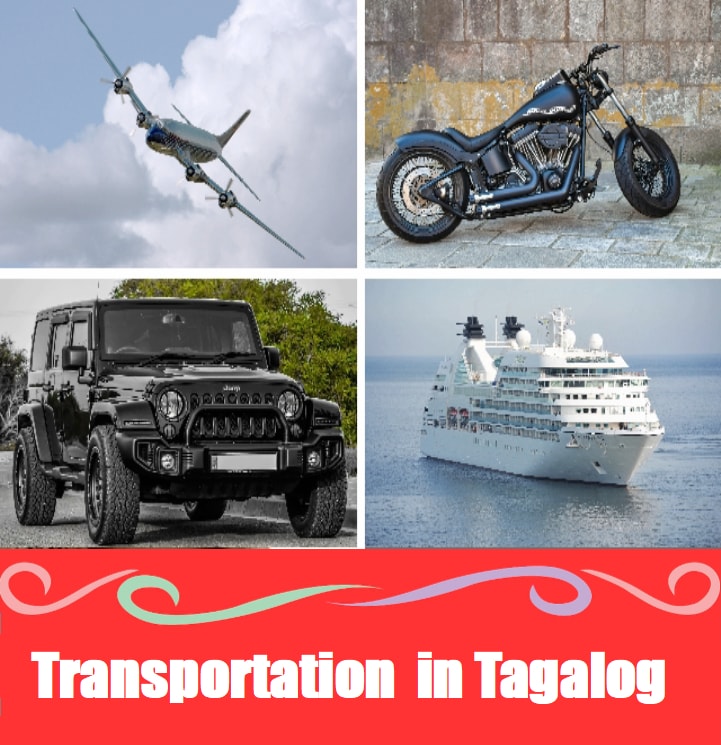
Introduction to Vehicles in Tagalog
What Are Vehicles in Tagalog?
The general word for vehicle in Tagalog is sasakyan.
The plural form is mga sasakyan.
The broader system of moving people and goods is called transportasyon.
Root word: Sakay (to ride)
Example:
- Anong sasakyan ang papunta roon?
- Maraming sasakyan sa kalsada ngayon.
Land Vehicles in Tagalog (Mga Sasakyang Panlupa)
In busy cities like Manila, land vehicles are part of the everyday rhythm and routine. From the early morning rush hour to late evening commutes, the streets come alive with constant movement. Engines start before sunrise. Jeepneys line up along major roads. Tricycles wait patiently inside neighborhoods. Buses gradually fill with workers heading to offices, while students squeeze into rides on their way to school.
When learning Vehicles in Tagalog, understanding land transportation is especially important because urban life depends heavily on mga sasakyang panlupa (land vehicles). These vehicles transport people to work, schools, markets, government offices, and family gatherings. They support small businesses, connect barangays to city centers, and keep local economies running.
For Filipino language learners, mastering Vehicles in Tagalog vocabulary helps you describe daily routines, commuting situations, and real-life conversations. Words like kotse, bus, dyip, and traysikel are commonly used in everyday speech. If you want to speak naturally, learning land transportation terms is one of the most practical steps in expanding your Tagalog vocabulary.
In many communities, transportation is shared and practical. Neighbors ride together. Drivers call out destinations. Commuters adjust to traffic and weather. Whether it’s a short trip to the sari-sari store, a commute across the city, or a long drive to the province, land transportation remains essential to everyday Filipino life.
Below are the most common Vehicles in Tagalog you’ll hear and see in the Philippines:
Common Land Vehicles
| English | Tagalog |
|---|---|
| Vehicle | Sasakyan |
| Car | Kotse |
| Bus | Bus |
| Jeepney | Dyip |
| Tricycle | Traysikel |
| Motorcycle | Motorsiklo |
| Bicycle | Bisikleta |
| Taxi | Taksi |
| Truck | Trak |
| Van | Van |
| Tractor | Traktora |
| Carriage | Karwahe |
Each of these vehicles in Tagalog plays a unique role in Filipino life:
- The kotse is common for families and private travel.
- The bus carries passengers across cities and provinces.
- The dyip (jeepney) is the colorful symbol of Filipino commuting culture.
- The traysikel is the neighborhood hero, perfect for short distances.
- The motorsiklo weaves through traffic with speed and flexibility.
- The bisikleta remains a simple, affordable, and eco-friendly option.
- The taksi offers convenient point-to-point travel.
- The trak and traktora support business, farming, and construction.
- The karwahe, though traditional, reminds us of Philippine history and heritage.
Land vehicles are more than transportation in the Philippines — they are part of daily survival, livelihood, and social life. They carry children to school, workers to opportunity, farmers to markets, and families back home at the end of a long day.
To understand Filipino life, you must understand the movement of its streets. And to speak Tagalog naturally, learning the names of these mga sasakyang panlupa is an essential first step.
Rail Vehicles in Tagalog (Mga Sasakyang Riles)
In the heart of Metro Manila, where traffic can stretch for hours and roads overflow with vehicles, trains offer a faster and more predictable way to travel. While jeepneys and buses dominate the streets, rail transportation moves steadily above or along the city — carrying thousands of passengers every single day.
For many office workers, students, and daily commuters, the sound of a passing train signals the beginning or end of a long day. The early morning rush at train stations, the organized lines on platforms, and the familiar announcement of arriving trains are part of urban Filipino life.
In Tagalog, rail vehicles fall under mga sasakyang riles — vehicles that run on tracks.
Common Rail Vehicles
| English | Tagalog |
|---|---|
| Train | Tren |
| Subway | Subway / Tren |
| Tram | Tram |
About These Rail Vehicles
- The tren is the most commonly used rail vehicle in the Philippines.
- While true underground subways are limited, the word subway is still understood and often used interchangeably with tren.
- A tram refers to lighter rail systems, though it is less common in the Philippines today.
Rail systems like the MRT and LRT help reduce travel time, especially during peak traffic hours. For many commuters, riding the train is part of daily routine — just like morning coffee or evening dinner with family.
Example Sentences – Rail Vehicles
- Tren – Narinig ko ang tunog ng tren.
- Sasakay ako ng tren papunta sa trabaho.
- Dumating na ang tren sa istasyon.
- Mahaba ang pila sa istasyon ng tren.
- Mas mabilis ang tren kaysa bus kapag may trapiko.
- Punô ang tren tuwing rush hour.
- Nag-aabang siya ng tren sa plataporma.
- Malinis ang loob ng tren ngayon.
- Nahuli ako dahil na-delay ang tren.
- Mas komportable ang biyahe kapag hindi siksikan ang tren.
Rail vehicles may not be as colorful as jeepneys, but they represent efficiency and modern urban life in the Philippines. For many Filipinos, the train is a symbol of daily perseverance — waking up early, lining up patiently, and traveling long distances to support their families.
Learning the word tren and other rail-related vocabulary helps you speak about real everyday experiences in the city. In a place where time and traffic matter, mga sasakyang riles play an essential role in keeping life moving forward.
Water Vehicles in Tagalog (Mga Sasakyang Pandagat)
In a country surrounded by water and made up of more than 7,000 islands, the sea is not a barrier — it is a bridge. In the Philippines, water shapes daily life, culture, and movement across regions.
When learning Vehicles in Tagalog, it is important to understand the role of water transportation. Because the Philippines is an archipelago, many communities depend on mga sasakyang pandagat (water vehicles) for travel, trade, and livelihood. These Vehicles in Tagalog are used on seas, rivers, and lakes to connect islands and coastal provinces.
Long before highways and rail systems developed, Filipinos were already skilled seafarers. Small wooden boats traveled between islands, fishermen prepared their nets before sunrise, and families relied on the sea for both income and mobility. Even today, water Vehicles in Tagalog remain essential in coastal towns and island provinces.
From the small bangka used for fishing to large passenger ships carrying travelers between regions, water transportation continues to connect people to work, markets, schools, and family gatherings. For Filipino language learners, understanding water-related Vehicles in Tagalog vocabulary helps you describe real-life travel situations across the country.
Below are the most common Vehicles in Tagalog used for water transportation in the Philippines:
Common Water Vehicles
| English | Tagalog |
|---|---|
| Boat | Bangka |
| Ship | Barko |
| Ferry | Lantsa |
| Submarine | Submarino |
About These Water Vehicles
- The bangka is one of the most iconic boats in the Philippines. Often made of wood with outriggers on the sides, it is used for fishing and short island trips.
- The barko is much larger and used for transporting goods and passengers between major ports.
- A lantsa (ferry) regularly carries commuters and vehicles between nearby islands.
- The submarino (submarine) travels underwater and is mostly associated with military or exploration purposes.
From peaceful lakes to deep oceans, these vehicles represent both survival and adventure.
Example Sentences – Water Vehicles
- Bangka – Nasa lawa ang bangka.
- Sumakay kami ng bangka papunta sa maliit na isla.
- Maagang pumalaot ang bangka ng mga mangingisda.
- Barko – Malaki ang barkong dumaong sa pantalan.
- Naglalakbay ang barko sa gitna ng karagatan.
- Lantsa – Sumakay ang mga pasahero sa lantsa papunta sa kabilang pulo.
- Dumating ang lantsa kahit maalon ang dagat.
- Submarino – Bumaba ang submarino sa ilalim ng karagatan.
- Nakakita kami ng modelo ng submarino sa museo.
- Mahalaga ang barko sa pagdadala ng produkto sa iba’t ibang isla.
Water vehicles reflect the true geography and spirit of the Philippines. They remind us that the country’s identity is deeply tied to the sea — to fishermen casting nets at sunrise, to families crossing islands for reunions, to cargo ships bringing goods that sustain communities.
Learning the names of these mga sasakyang pandagat is more than vocabulary practice. It is understanding how Filipinos live between islands — always moving, always connecting, always guided by both land and sea.
Air Vehicles in Tagalog (Mga Sasakyang Panghimpapawid)
In a country made up of thousands of islands, distance is not just measured in kilometers — it is measured in water crossings and flight hours. While boats connect nearby provinces, air travel allows people to move quickly across regions in just a few hours.
When learning Vehicles in Tagalog, understanding air transportation is essential. In Tagalog, air vehicles are called mga sasakyang panghimpapawid — vehicles that travel through the air. These Vehicles in Tagalog play a major role in connecting major cities, remote islands, and even international destinations.
For many Filipinos, riding an airplane is deeply meaningful. It may mean going home for Christmas, attending a wedding in another province, starting a new job abroad, or reuniting with family after years apart. Airports are often filled with emotional goodbyes and joyful reunions. Because of this, air-related Vehicles in Tagalog vocabulary are commonly heard in real-life conversations about travel, migration, and family life.
From the eroplano that carries hundreds of passengers to the helikopter used for rescue and special transport, air Vehicles in Tagalog symbolize speed, opportunity, and connection. For Filipino language learners, mastering these terms helps you confidently discuss flights, airports, and travel experiences.
Below are the most common Vehicles in Tagalog used for air transportation:
Common Air Vehicles
| English | Tagalog |
|---|---|
| Airplane | Eroplano |
| Helicopter | Helikopter |
About These Air Vehicles
- The eroplano is the most common air vehicle, used for domestic and international travel.
- The helikopter is smaller and more flexible, often used for rescue missions, news coverage, military operations, or reaching remote areas.
Air travel allows people to cross vast distances that would otherwise take days by sea. What once required long boat journeys can now be done in a short flight above the clouds.
Example Sentences – Air Vehicles
- Eroplano – Ito ang pinakaligtas na eroplano na ginawa.
- Sasakay kami ng eroplano bukas.
- Lumilipad ang eroplano sa itaas ng ulap.
- Dumating na ang eroplano sa paliparan.
- Mahaba ang biyahe kapag delayed ang eroplano.
- Helikopter – Lumilipad ang helikopter sa ibabaw ng gubat.
- Dumating ang helikopter upang maghatid ng tulong.
- Mabilis ang paglalakbay kapag naka-helikopter.
- Narinig namin ang malakas na tunog ng helikopter.
- Ginamit ang helikopter sa rescue operation.
Air vehicles represent speed, connection, and possibility. When studying Vehicles in Tagalog, air transportation is an important category to understand. In the Philippines, where oceans separate many communities, the eroplano plays a vital role in shortening distances and bringing families closer together. These air Vehicles in Tagalog make regional and international travel faster and more accessible.
The helikopter, another example of air Vehicles in Tagalog, is often seen during urgent situations. It delivers aid to remote areas, rescues people during natural disasters, and monitors important events. Because of this, air transportation vocabulary is commonly used in news reports and everyday conversations.
Learning the words eroplano and helikopter strengthens your Vehicles in Tagalog vocabulary, especially when talking about flights, airports, travel plans, and emergency response. For Filipino language learners, these terms are practical and frequently used in real-life situations.
In a nation shaped by land and sea, the sky has become another pathway. Through air Vehicles in Tagalog, people experience reunions, new opportunities, and meaningful journeys — proving that transportation is not just about movement, but connection.
Emergency and Special Vehicles in Tagalog (Mga Sasakyang Pang-emerhensiya)
Not all vehicles are used for daily commuting or travel. Some appear during the most urgent and critical moments of life. When there is danger, accident, fire, or mechanical trouble, special vehicles respond quickly to protect people and restore safety.
In the Philippines, the sound of a siren immediately catches attention. Cars move aside. Pedestrians stop. Traffic parts to give way. These vehicles symbolize protection, rescue, and public service. Whether in busy cities or quiet provinces, emergency vehicles play a vital role in keeping communities safe.
In Tagalog, they are often referred to as mga sasakyang pang-emerhensiya — vehicles used during emergencies.
Common Emergency Vehicles
| English | Tagalog |
|---|---|
| Ambulance | Ambulansya |
| Fire truck | Trak na pamatay-sunog |
| Police car | Sasakyan ng pulis |
| Tow truck | Tow truck / Trak panghila |
About These Emergency Vehicles
- The ambulansya transports sick or injured people to the hospital.
- The trak na pamatay-sunog responds to fires and rescue operations.
- The sasakyan ng pulis patrols communities and maintains peace and order.
- The tow truck (or trak panghila) helps when vehicles break down or are involved in accidents.
These vehicles are not part of everyday routine rides — but when they appear, they bring urgency and assistance.
Example Sentences – Emergency Vehicles
- Ambulansya – Naghintay kami ng ambulansya.
- Dumating agad ang ambulansya sa ospital.
- Tumawag sila ng ambulansya para sa pasyente.
- Mabilis ang takbo ng ambulansya dahil emergency.
- Sasakyan ng pulis – Nagpapatrolya ang sasakyan ng pulis sa gabi.
- Mabilis ang takbo ng sasakyan ng pulis.
- Huminto ang sasakyan ng pulis sa tabi ng kalsada.
- Narinig namin ang sirena ng sasakyan ng pulis.
- Tow truck – Dinala ng tow truck ang sirang kotse sa talyer.
- Tumawag siya ng tow truck dahil nasiraan siya.
- Hinila ng tow truck ang sasakyan mula sa gitna ng kalsada.
- Trak na pamatay-sunog – Dumating ang trak na pamatay-sunog upang apulahin ang apoy.
- Mabilis na rumesponde ang trak na pamatay-sunog.
- Nagbigay ng tulong ang mga bumbero mula sa trak na pamatay-sunog.
Emergency vehicles represent safety, order, and community care. They appear during moments of fear and uncertainty — yet they bring reassurance and hope.
Learning these words in Tagalog allows you to speak about real-life situations that matter: accidents, rescue operations, safety, and public service. Beyond vocabulary, these terms reflect the Filipino value of bayanihan — helping one another, especially in times of need.
In every siren heard across the streets, there is a reminder that someone is responding, someone is helping, and someone is protecting the community.
Heavy and Construction Vehicles in Tagalog (Mga Mabibigat na Sasakyan sa Konstruksyon)
Not all vehicles carry passengers. Some are built for strength, power, and hard labor. Across cities and provinces in the Philippines, construction sites are signs of growth — new roads, bridges, buildings, and homes rising from the ground.
From early morning until sunset, heavy machines roar, lift, dig, and transport materials. These vehicles may not be as colorful as jeepneys or as fast as airplanes, but they play a crucial role in building communities and supporting development.
In Tagalog, these are often called mga mabibigat na sasakyan or mga sasakyang pang-konstruksyon — heavy or construction vehicles.
Common Heavy and Construction Vehicles
| English | Tagalog |
|---|---|
| Backhoe | Backhoe |
| Crane | Krane |
| Dump truck | Dump truck |
| Forklift | Forklift |
| Cement truck | Truck ng semento |
| Front loader | Front loader |
(Note: Many construction vehicle names are borrowed from English and commonly used as-is in Filipino conversations.)
Example Sentences – Heavy Vehicles
- Backhoe – Makakahukay ang backhoe ng malalim na lupa.
- Ginagamit ang backhoe sa paghuhukay ng pundasyon.
- Krane – Kailangan natin ng krane upang itaas ito.
- Itinaas ng krane ang mabigat na bakal.
- Dump truck – Umatras ang dump truck sa construction site.
- Punô ng graba ang dump truck.
- Forklift – Ginagamit ang forklift upang magbuhat ng mabibigat na karga.
- Maingat na minaneho ang forklift sa bodega.
- Truck ng semento – Malakas ang makina ng truck ng semento.
- Dumating na ang truck ng semento sa gusali.
- Ibinoso ng truck ng semento ang halo sa pundasyon.
- Maingay ang mga mabibigat na sasakyan sa lugar ng konstruksyon.
Heavy and construction vehicles represent progress and development. Every road widened, every bridge completed, and every building constructed begins with machines like the backhoe, krane, and dump truck.
While they may seem purely mechanical, these vehicles support workers, provide jobs, and shape the infrastructure of growing communities. Learning these terms in Tagalog helps you describe real-world environments — from construction sites to warehouses and farms.
In many ways, these powerful machines are the quiet builders behind modern Filipino life — strong, steady, and essential to the nation’s growth.
Frequently Asked Questions (FAQ)
1. What is vehicle in Tagalog?
Vehicle in Tagalog is sasakyan.
2. What is transportation in Tagalog?
Transportation in Tagalog is transportasyon.
3. What is the plural of sasakyan?
The plural form is mga sasakyan.
4. What is jeepney in Tagalog?
Jeepney in Tagalog is dyip.
5. How do you say “ride” in Tagalog?
The verb is sumakay.
6. What do you say to stop a jeepney?
You say “Para po.”
7. What is train in Tagalog?
Train in Tagalog is tren.
8. What is boat in Tagalog?
Boat in Tagalog is bangka.
Conclusion
Vehicles in Tagalog are more than vocabulary words — they reflect everyday Filipino life. The word sasakyan (vehicle) represents movement, connection, and daily routine across the Philippines. From land transportation like kotse and bus, to watercraft such as bangka and barko, and air travel through eroplano and helikopter, vehicles connect families, communities, and islands throughout the country.
In a nation made up of over 7,000 islands, transportation is essential. Students ride the bus or traysikel to school. Workers take the tren or jeep to the office. Fishermen travel by bangka, while farmers use a traktora in the fields. During emergencies, the ambulansya and trak na pamatay-sunog respond quickly. On construction sites, heavy equipment like the backhoe and dump truck help build infrastructure that supports national growth.
Learning Vehicles in Tagalog by type — land, rail, water, air, emergency, and heavy equipment — improves your practical Filipino vocabulary. These are real-life words used in conversations, travel situations, school lessons, and daily communication. Understanding the meaning and usage of sasakyan helps learners speak more naturally and confidently.
Transportation supports education, business, tourism, safety, and family life in the Philippines. It connects rural areas to cities, provinces to regions, and people to opportunities. Because of this, mastering Vehicles in Tagalog vocabulary is an important step for beginners, students, homeschoolers, and Filipino language learners.
Ultimately, Vehicles in Tagalog are not just terms to memorize — they represent how Filipinos live, work, and move forward together. Whether traveling by land, sea, or air, every journey begins with a sasakyan. And with the right Tagalog vocabulary, you can confidently describe that journey in everyday conversation.