Houseflies are common insects found in homes, farms, public markets, and gardens across the Philippines. Because the country has a warm and humid climate, they remain active throughout the year. While they are often considered pests, houseflies are also part of the natural ecosystem.
In Tagalog, a housefly is called langaw.
This guide explains the meaning of housefly in Tagalog, useful vocabulary words, example sentences, anatomy, and important facts about houseflies in the Philippines.
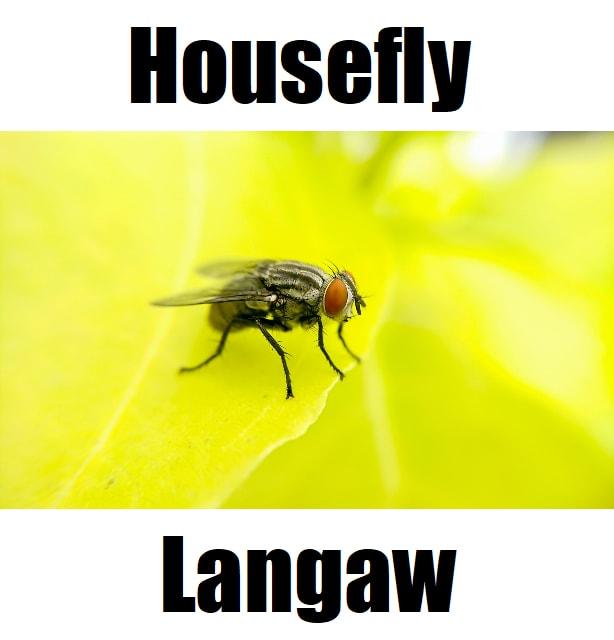
Table of Contents
Housefly Vocabulary Words in Tagalog
Here are common Tagalog words connected to houseflies and their environment:
- Langaw – housefly
- Insekto – insect
- Hayop – animal
- Bahay – house
- Peste – pest
- Sakit – disease
- Marumi – dirty
- Bukid – farm
- Hardin – garden
- Hayop na walang buto – invertebrate
These vocabulary words help describe the housefly’s behavior, habitat, and impact in daily Filipino life. By understanding these terms, learners can better explain where houseflies live, how they survive, and why they are commonly seen in homes, markets, and farms throughout the Philippines. Expanding your vocabulary also improves your ability to discuss sanitation, environmental conditions, and everyday situations involving insects in both casual conversations and educational settings.
Example Sentences Using “Housefly” in Tagalog
Here are practical Tagalog sentences to help you understand how to use langaw in conversation:
Ang mga langaw ay nagdadala ng sakit sa tahanan.
Houseflies carry diseases into the home.
Ang langaw ay kumakain ng likidong pagkain.
A housefly feeds on liquid food.
Ang langaw ay tumitikim ng pagkain gamit ang kanilang mga paa.
A housefly tastes food with its feet.
Ang langaw ay maaaring maglakad ng patiwarik.
A housefly can walk upside down.
Ang mga langaw ay nangingitlog sa pagkain.
Houseflies lay eggs on food.
Ang mga langaw ay may napakabilis na reaksyon sa mga galaw.
Houseflies have very fast reactions to movement.
Ang langaw ay may matalas na pang-amoy.
A housefly has a strong sense of smell.
Karamihan sa mga langaw ay nabubuhay sa loob ng isang buwan.
Most houseflies live for about a month.
These example sentences show how the word langaw is naturally used in everyday Tagalog conversations. By reading and practicing them, you not only improve your vocabulary but also gain a clearer understanding of the housefly’s behavior, characteristics, and role in daily life in the Philippines. Repetition and real-life context help reinforce learning, making it easier to remember the word and use it confidently in both spoken and written Filipino.
🪰 Anatomy of a Housefly (Langaw)
The housefly, scientifically known as Musca domestica, has a compact but highly specialized body adapted for survival in human environments. Like all insects, its body has three main sections: head, thorax, and abdomen. It is protected by a hard outer covering called an exoskeleton.
🧠 Head (Senses and Feeding)
- Compound Eyes – Provide almost 360-degree vision
- Antennae – Detect smells and air movement
- Proboscis – Sponge-like mouthpart used to absorb liquid food
- Palps – Assist in sensing and handling food
Houseflies do not bite. Instead, they release saliva to soften solid food before absorbing it.
🦵 Thorax (Movement and Flight)
- Two Wings – Used for flight
- Halteres – Help maintain balance during flight
- Three Pairs of Legs – Contain sticky pads and taste receptors
This explains why flies appear to walk over food before eating.
🫁 Abdomen (Digestion and Reproduction)
- Flexible and segmented
- Contains digestive and reproductive organs
- Females lay eggs in moist organic material
A single female housefly can lay hundreds of eggs during her lifetime, often depositing them in batches in moist organic material. Because the life cycle from egg to adult can take as little as one to two weeks under warm conditions, populations can increase rapidly when food sources and breeding sites are readily available. This high reproductive capacity explains why houseflies can quickly become noticeable in homes, farms, and public spaces if proper sanitation is not maintained.
Houseflies in the Philippines
Houseflies are active year-round in the Philippines because of the tropical climate. Warm temperatures and humidity allow continuous breeding.
They are especially common in:
- Public markets
- Farms and poultry facilities
- Coastal communities
- Urban residential areas
While houseflies are often associated with sanitation issues, they also play ecological roles. They help break down organic waste and contribute to nutrient recycling. They also serve as food for birds, reptiles, frogs, and other insects.
According to the World Health Organization (WHO), flies can act as mechanical carriers of certain bacteria. You can read more about disease transmission from WHO.
More detailed biological information about Musca domestica is available from Britannica.
In the Philippines, fly management focuses primarily on sanitation, waste control, and environmental cleanliness rather than relying only on chemicals.
Breeding and Habitat
Houseflies thrive in:
- Garbage and food waste
- Animal manure
- Rotting organic matter
- Poorly sanitized environments
Although present throughout the year, populations increase faster during hotter months when breeding cycles accelerate.
Control and Management Methods
Effective control combines prevention and sanitation.
1. Sanitation (Most Effective)
- Dispose of garbage properly
- Keep food covered
- Clean animal waste immediately
- Maintain proper drainage systems
2. Physical Controls
- Flyswatters
- Sticky traps
- Window and door screens
3. Professional Services
For larger infestations, pest control providers may use:
- ULV misting
- Foaming treatments
- Residual sprays
These are common in farms and food production areas.
❓ FAQ About Housefly in Tagalog
1. What is housefly in Tagalog?
Housefly in Tagalog is langaw.
2. What is the scientific name of the housefly?
The scientific name is Musca domestica.
3. How long does a housefly live?
Most live between 2 to 4 weeks.
4. Why do houseflies rub their legs together?
They clean their legs to improve grip and taste sensitivity.
5. Are houseflies found throughout the Philippines?
Yes, they are present nationwide due to the warm climate.
6. Do houseflies have any ecological benefits?
Yes. They help decompose organic material and serve as prey for other animals.
7. Why are houseflies more active during hot months?
Higher temperatures speed up their life cycle and reproduction rate.
Conclusion
Learning the meaning of housefly in Tagalog — langaw — helps expand your vocabulary about insects, sanitation, and daily life in the Philippines. Beyond being household pests, houseflies are part of a larger ecological system shaped by the country’s climate and environment.
Understanding their behavior, anatomy, and habitat allows for better awareness and more effective control, especially in tropical regions where they remain active all year.