Insect Names in Tagalog are important vocabulary words for students, kids, and Filipino language learners. In Tagalog, insects are called mga insekto. These tiny creatures appear everywhere in Filipino daily life — in gardens, farms, forests, rice fields, and even inside homes.
Some of the most common types of insects in English include ants, bees, butterflies, beetles, mosquitoes, flies, grasshoppers, dragonflies, termites, and crickets. Learning their Insect Names in Tagalog helps expand vocabulary while making it easier to describe nature and everyday experiences.
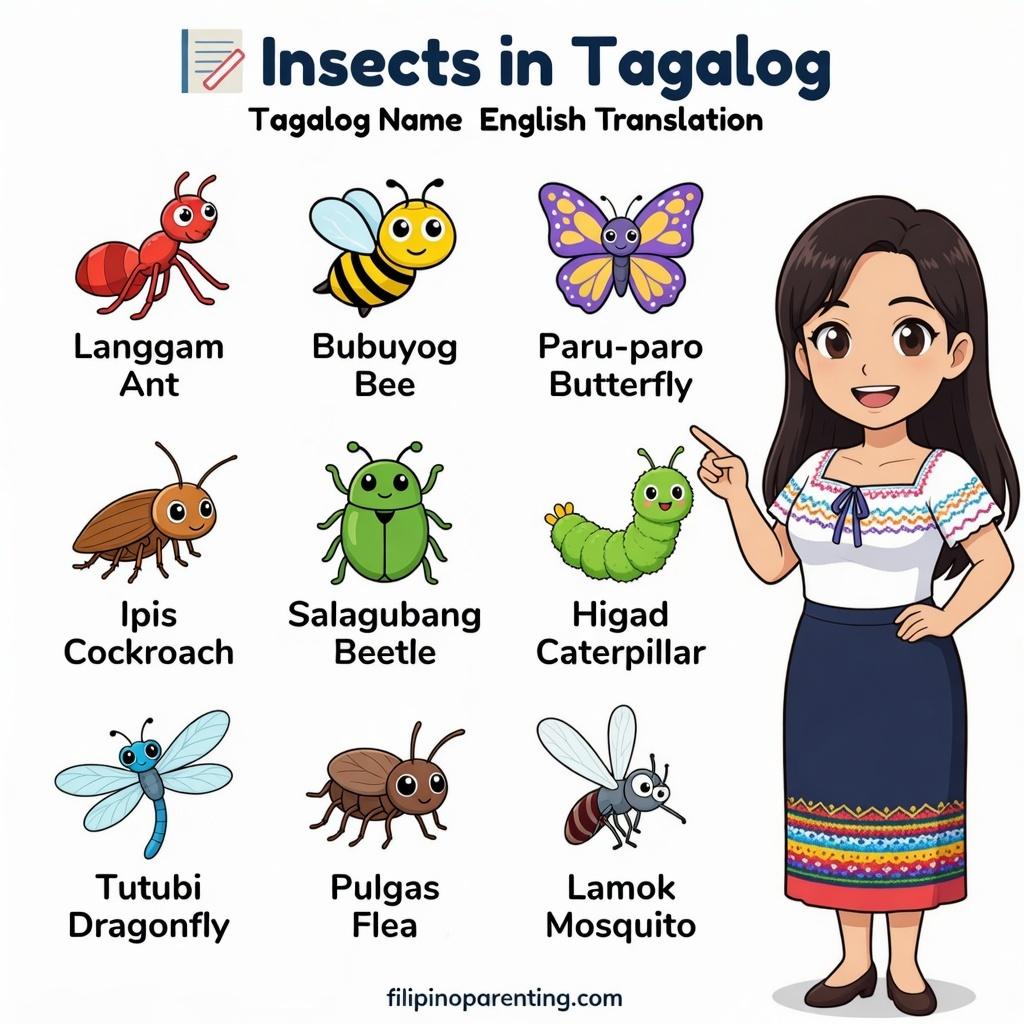
Table of Contents
What Are Insects Called in Tagalog?
The general word for insect in Tagalog is:
Insekto – insect
Another commonly used word is:
Kulisap – small insect or bug
Both words are used when referring to different kinds of insects in Filipino conversations, including flying insects, crawling insects, garden insects, and household pests.
Common insect groups in English include:
- Flying insects (butterflies, bees, mosquitoes)
- Crawling insects (ants, beetles, termites)
- Garden insects (grasshoppers, caterpillars, dragonflies)
- Household insects (cockroaches, flies, ants)
🐜 Common Insect Names in Tagalog (With English Translation)
Learning common Insect Names in Tagalog helps students, kids, and Filipino language learners describe nature more confidently. Insects are part of everyday life in the Philippines — from gardens and rice fields to kitchens and classrooms.
Below is a clear and organized list of frequently used insect names in Tagalog, along with their English translations. This table makes it easier to study, teach, and remember these important vocabulary words.
📚 List of Common Insects in Tagalog
| Tagalog Name | English Translation |
|---|---|
| Langgam | Ant |
| Bubuyog | Bee |
| Paru-paro | Butterfly |
| Ipis | Cockroach |
| Gagamba | Spider |
| Salagubang | Beetle |
| Higad | Caterpillar |
| Tutubi | Dragonfly |
| Pulgas | Flea |
| Lamok | Mosquito |
| Langaw | Housefly |
| Tipaklong | Grasshopper |
| Gamu-gamo | Moth |
| Putakti | Wasp |
| Alitaptap | Firefly |
| Anay | Termite |
| Kuliglig | Cricket |
| Samba-samba | Praying Mantis |
| Kuto | Lice |
| Garapata | Tick |
| Hantik | Weaver Ant |
| Tayangaw | Stink Bug |
| Surot | Bed Bug |
| Uwang | Rhinoceros Beetle |
🔍 Interactive Tagalog Learning Resources
Using these example sentences while you’re out in the garden or cleaning the house is a fantastic way for beginners and parents to normalize Tagalog in the home. It’s one thing to know that an ant is a langgam, but it’s much more impactful to describe its behavior in the kitchen!
If you want to take this learning off the screen and into the backyard, don’t forget to pair these sentences with our specialized charts below. They are a great way for families to practice these exact phrases while observing nature in real-time.
🦋 1. High-Flyers: Winged Insects in the Philippines
If you’ve ever spent a humid evening on a Pinoy terasa, you know that the air is often filled with more than just the scent of Sampaguita. Mastering the names of flying insects in Tagalog isn’t just a vocabulary drill; it’s about knowing exactly what is buzzing around your meryenda!
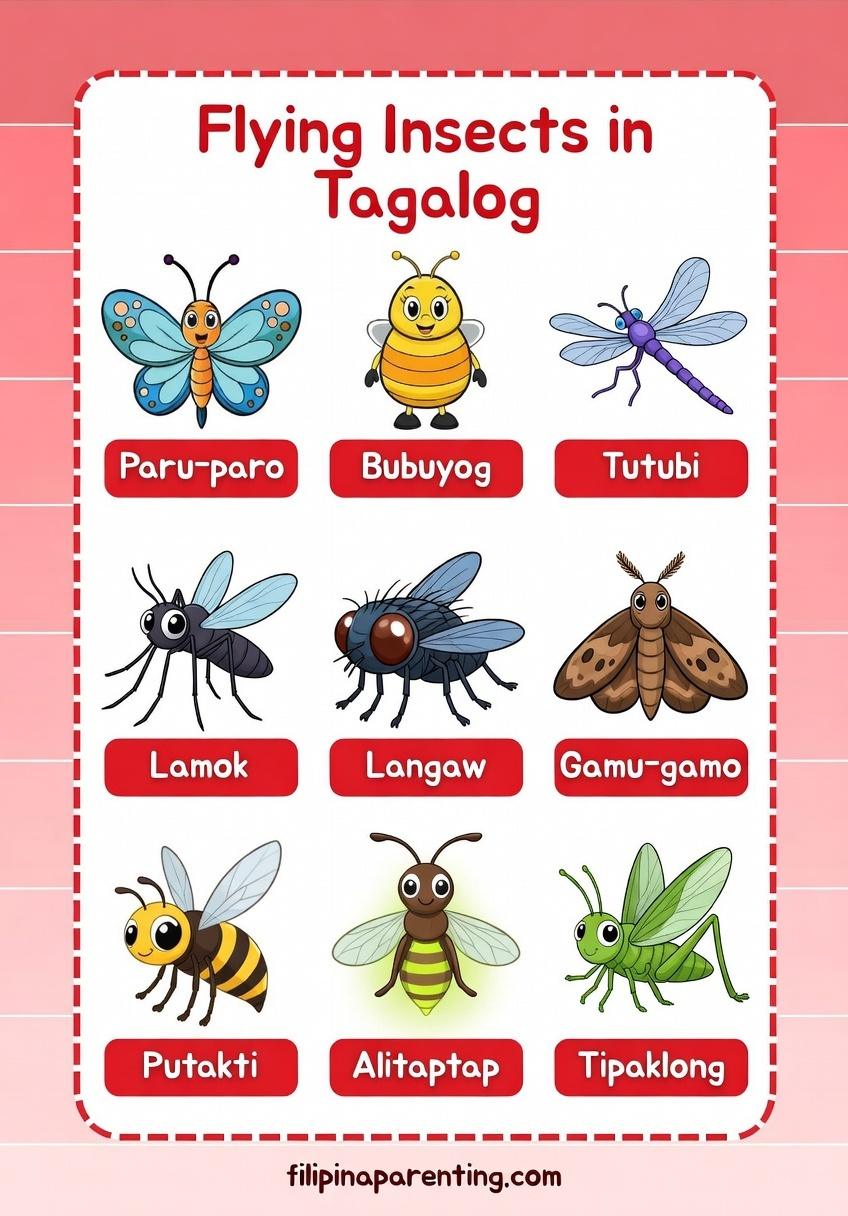
While our list of insects in Tagalog includes the usual suspects, a few carry deep cultural weight in the Philippines:
- Alitaptap (Firefly): These “living lanterns” are a nostalgic symbol of provincial life. If you’re lucky enough to see them, it’s a sign of a healthy ecosystem—and a perfect moment to practice the word with the younger generation.
- Gamu-gamo (Moth): Unlike the colorful Paru-paro (Butterfly) that loves the sun, the Gamu-gamo is drawn to the flame. This gave us one of our most famous national parables: the “Story of the Moth” told to a young Jose Rizal, teaching us that sometimes, chasing the brightest light comes with a price.
- Putakti (Wasp): These are the “smart” flyers you want to avoid. Their Tagalog name has a sharp, staccato sound that perfectly matches their aggressive nature. Real-talk: if you spot a nest, it’s time to head back inside!
Looking for more? You can find our high-quality, printable versions of these charts in the download section at the bottom of this post!
🐜 2. Crawling Insects & The 6-Leg Rule
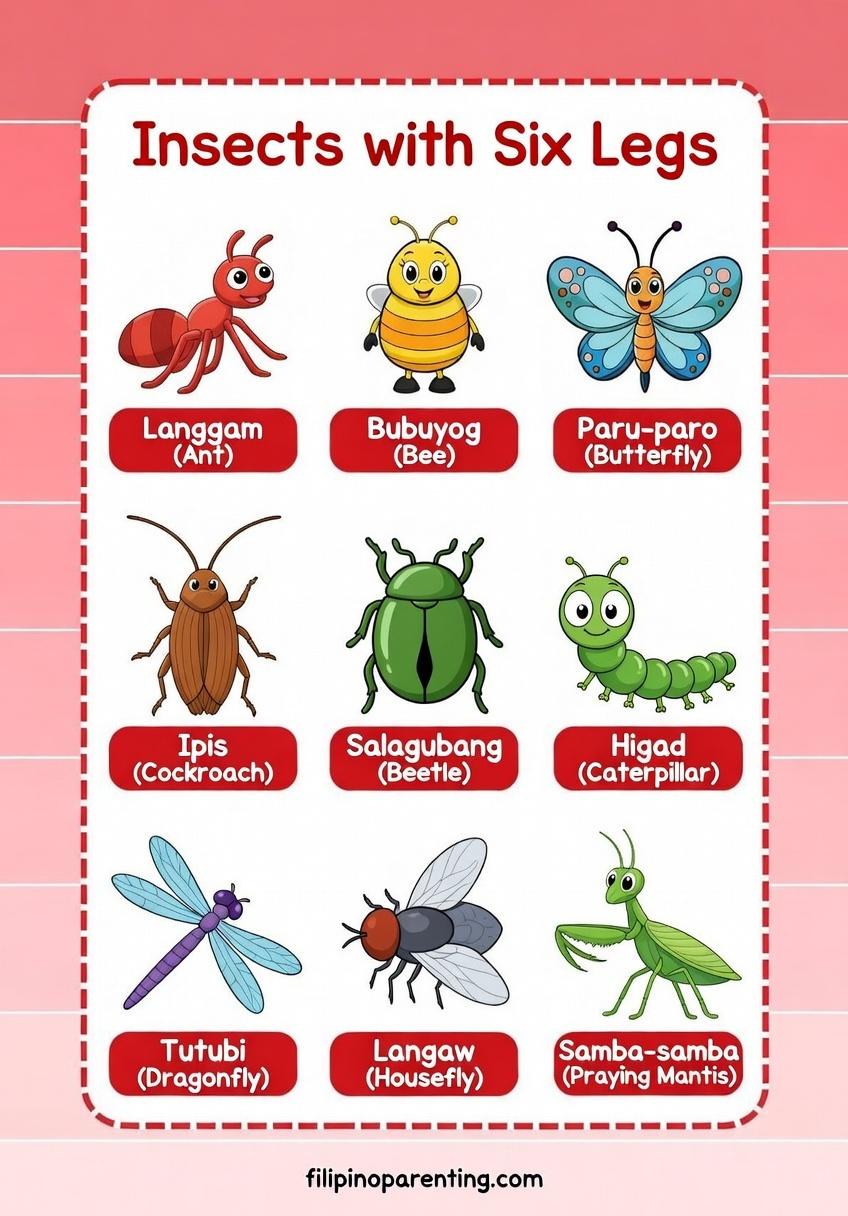
What are the most common types of insects in Tagalog that stay grounded? Scientifically, for a creature to be classified as an insect, it must have exactly six legs. While our Paru-paro (Butterfly) and Bubuyog (Bee) have six legs, they are the “pilots” of the garden. In this section, we focus on the “pedestrians”—the crawling insects that beginners and parents will likely spot on the floor or under a leaf.
Featured “Ground” Vocabulary:
- Ipis (Cockroach): The ultimate survivor and a staple of “Real-Talk” stories in every Filipino kitchen.
- Salagubang (Beetle): A sturdy, six-legged crawler that is a classic find in garden soil.
- Higad (Caterpillar): Before it gets its wings, it spends its days crawling. Note: It has six true legs near its head!
- Langgam (Ant): The most common six-legged neighbor you’ll find marching across the pavement.
Fascinating Fact: This section’s star is the Salagubang (Beetle). In the province, the older generation used to tie a thin sewing thread to one of its legs and let it fly in circles like a tiny, natural drone—a classic Filipino “toy” from the days before gadgets!
⏳ How Long Do They Live? Tagalog Insect Lifespans
One of the most frequent questions about insects in the Philippines is: “How long do they live?” This chart is perfect for advanced learners and parents who want to incorporate science into their Tagalog lessons.
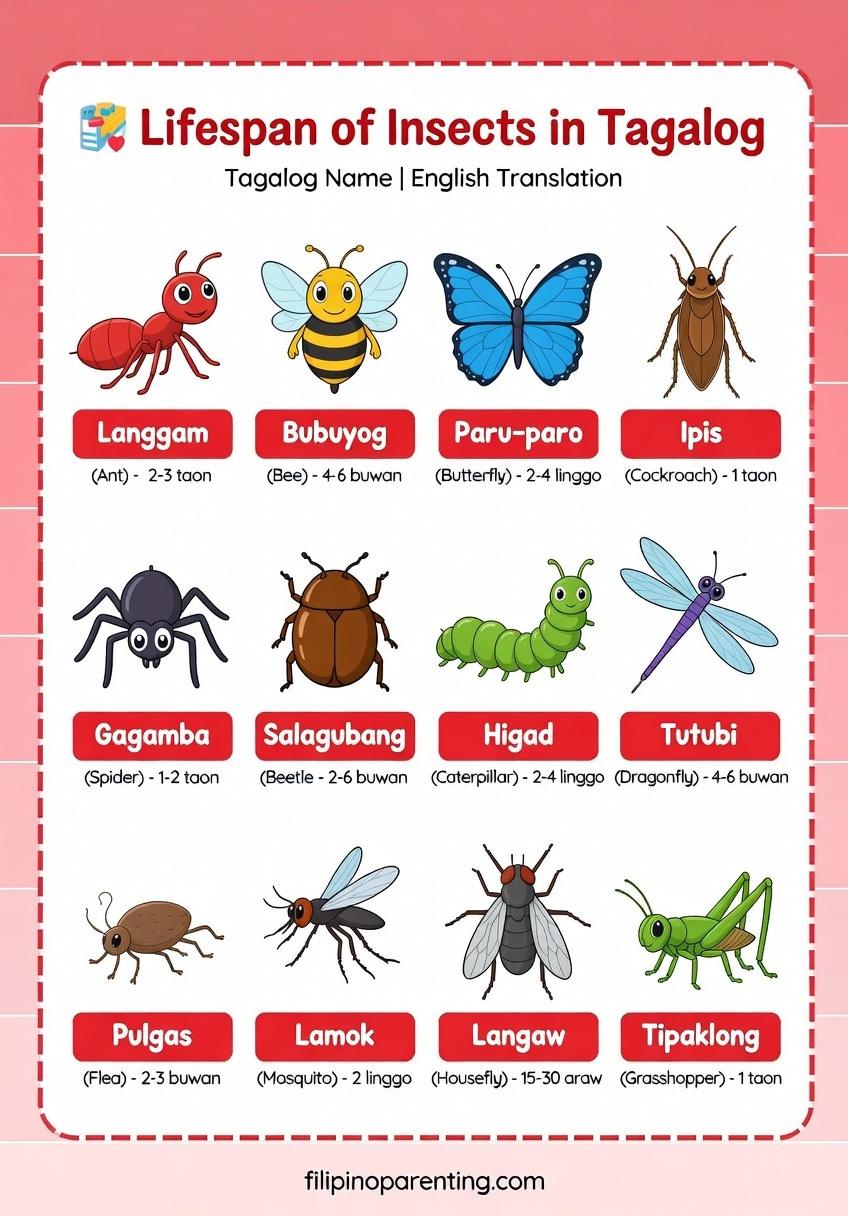
Real-Talk Observation: Notice that the Ipis (Cockroach) can live for a whole year (isang taon), while the Langaw (Housefly) only lasts about 15-30 days (araw). It explains why it feels like the same cockroach has been haunting your pantry for months!
Vocabulary Note: Use our lifespan chart to practice time-related words like:
- Araw (Days)
- Linggo (Weeks)
- Buwan (Months)
- Taon (Years)
⚠️ A Note on the Gagamba (Spider): You’ll see the Gagamba included in our lifespan chart because it’s a common “house guest” in the Philippines. However, here is a bit of “Real-Talk” science: technically, a spider is an Arachnid, not an insect. You can tell the difference by counting the legs! Insects have six, while spiders have eight.
Ready to start learning? Look for the high-quality PDF download link at the bottom of this post!
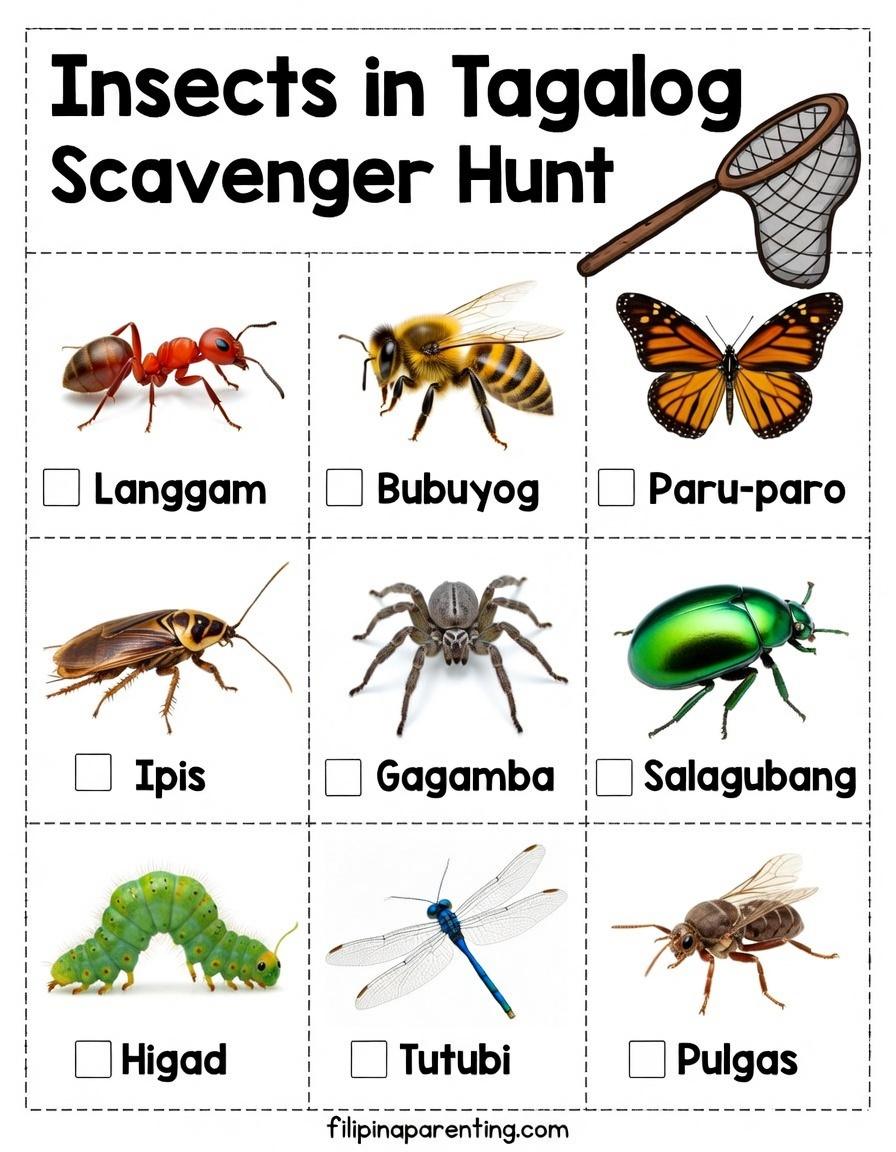
🗺️ The Ultimate Outdoor Challenge: Tagalog Nature Scavenger Hunt
Ready to put your knowledge to the test? Learning the meaning of insects in Tagalog is much more effective when you are actually looking at them! Our Filipino Wildlife Scavenger Hunt is designed for families to take into the backyard, park, or province.
Safety First: A “Real-Talk” Guide for Parents
Before you head out with your magnifying glass, let’s talk safety. While we want the younger generation to explore, there are a few creatures on this list that are strictly “Look, Don’t Touch”:
- Bubuyog (Bee) & Putakti (Wasp): These are vital for the environment, but they can be “stinging insects in Tagalog” if disturbed. Remind your learners to observe their hard work from a distance.
- Higad (Caterpillar): Real-talk: That “fluff” is actually irritating hair! Touching a higad can lead to intense itching and skin rashes.
- Gagamba (Spider): While most common house spiders are harmless, it’s best to teach the younger generation to admire their webs without getting too close.
How to Use This Printable for Active Learning
To make this a true educational experience, don’t just check the boxes. Use the “Smart Facts” we’ve gathered:
- The “Imposter” Alert: As you hunt, remind your learners that the Gagamba is the “special guest” on this list. Count the legs together—you’ll find eight, making it an Arachnid, unlike the six-legged true insects like the Salagubang (Beetle).
- Practice Your Verbs: Is the Tutubi (Dragonfly) flying (lumilipad) or is the Langgam (Ant) crawling (gumagapang)?
- Identify the Life Stages: If you find a Higad, explain that you’re actually looking at a future Paru-paro (Butterfly)!
Pro-Tip for Parents: Print this out and laminate it! You can use a dry-erase marker so you can reuse the chart for every nature walk. It’s a fantastic way to normalize Tagalog insect names through safe, hands-on observation.
Example Sentences Using Insect Names in Tagalog
Here are simple, natural, and easy-to-understand example sentences to help you use these insect names in Tagalog correctly in daily conversations, classroom activities, and beginner Filipino lessons. These examples show how common insects like ants, bees, butterflies, mosquitoes, and grasshoppers are naturally used in both English and Tagalog sentences.
An ant is an industrious worker.
Ang langgam ay masipag na trabahador.
A bee makes sweet honey for food.
Ang bubuyog ay gumagawa ng matamis na pulot bilang pagkain.
A beetle lives on top of tree branches.
Ang salagubang ay naninirahan sa taas ng mga sanga ng puno.
A butterfly has colorful wings.
Ang paru-paro ay may makulay na mga pakpak.
A cockroach lives in damp places.
Ang ipis ay naninirahan sa mga maumidong lugar.
A dragonfly has large eyes.
Ang tutubi ay may malalaking mata.
The grasshopper eats lots of green leaves.
Ang tipaklong ay kumakain ng maraming dahon na luntian.
A housefly can be found in the garbage.
Ang langaw ay makikita kung saan may basura.
A mosquito net is used as protection from mosquito bites.
Ang kulambo ay gamit na proteksyon laban sa mga kagat ng lamok.
A spider has venomous fangs.
Ang gagamba ay may makamandag na mga pangil.
By practicing these sentences, you’re not just memorizing a list of insects in Tagalog; you’re learning how to describe the world around you in a natural, “Real-Talk” way. Whether you are discussing the industrious Langgam (Ant) or the protective Kulambo (Mosquito net), using these insect names in Tagalog in full sentences is the fastest way to build fluency for both parents and the younger generation.
Why Learn Insect Names in Tagalog?
Learning Insect Names in Tagalog helps:
- Improve Filipino vocabulary
- Teach children about nature and common animals
- Prepare for school science lessons
- Improve conversational Tagalog
- Understand environmental and agricultural topics
Many common insects such as ants, mosquitoes, termites, beetles, and butterflies play important roles in ecosystems. Knowing their names in both English and Tagalog makes learning more complete and practical.
Connecting vocabulary to real-life experiences makes language learning easier and more enjoyable.
Frequently Asked Questions (FAQ) About Insects in Tagalog
What is the insect meaning in Tagalog? The primary insect meaning in Tagalog is insekto. However, “bug” is often translated as kulisap, which refers to small crawling or flying creatures found in gardens and homes.
What are the different types of insects in Tagalog? There are many types of insects in Tagalog categorized by their behavior:
- Crawling insects in Tagalog: Langgam (ant), anay (termite), and ipis (cockroach).
- Flying insects in Tagalog: Paru-paro (butterfly), bubuyog (bee), and langaw (housefly).
- Stinging insects in Tagalog: Putakti (wasp) and certain types of bubuyog.
What is a cricket insect in Tagalog meaning? A cricket insect in Tagalog is called a kuliglig. They are well-known for the distinct chirping sounds they make at night in rural Filipino areas.
What is the “kamaru” insect in Tagalog meaning? Kamaru refers to a mole cricket. In some regions of the Philippines, such as Pampanga, these are considered a delicacy and are one of the insects eaten in the Philippines.
Are spiders (gagamba) considered insects? In casual conversation, many people group gagamba with tagalog insects, but they are technically arachnids because they have eight legs, whereas true insects have six.
🎥 Master Insect Names in Tagalog: Video Flashcards
Enhance your learning experience with our Tagalog Insect Vocabulary Flashcards video! This short, engaging clip is designed for parents and beginners to master essential insect names in Tagalog through clear visual and auditory cues. By watching and listening, you can ensure your pronunciation is accurate before teaching the younger generation.
Vocabulary Featured in the Video
Use this list to follow along and practice these common insect names in Tagalog:
- Langgam – Ant
- Bubuyog – Bee
- Paru-paro – Butterfly
- Ipis – Cockroach
Why Use These Video Flashcards?
- Correct Pronunciation: Hear the native Tagalog terms for common household insects clearly spoken to build your confidence.
- Visual Association: Vibrant illustrations help beginners instantly connect the Tagalog name to the English translation.
- Bite-Sized Learning: In just 10 seconds, you can reinforce four foundational insect names in Tagalog used in daily Filipino life.
Real-Talk Tip: Once you’ve mastered these four, dive deeper into our “Ultimate Guide” to learn about the Tutubi (Dragonfly), Salagubang (Beetle), and the Lamok (Mosquito). Remember the “Real-Talk” science: while the Gagamba (Spider) is a common house guest, its eight legs mean it isn’t technically an insect!e to learn about the Tutubi (Dragonfly), Salagubang (Beetle), and the difference between insects and the eight-legged Gagamba (Spider).
Final Thoughts on Insect Names in Tagalog
Now that you’ve mastered this comprehensive list of insects in Tagalog, you can start using these words in your daily life—whether you’re identifying kinds of bugs in the Philippines during a nature walk or teaching the younger generation about biodiversity.
Language learning becomes much more natural when you connect vocabulary to real-world sights. Instead of just saying “butterfly,” try using Paru-paro when you see one in the garden, or listen for the distinct chirping of the Kuliglig (Cricket) at night. Whether you are spotting a majestic Samba-samba (Praying Mantis) on a leaf or watching a Tipaklong (Grasshopper) leap through the grass, every interaction is a chance to practice.
Keep practicing these insects Tagalog names, and you’ll find yourself speaking more confidently with every conversation. From the common Langaw (Housefly) to the elusive Alitaptap (Firefly), these names are a gateway to better understanding Filipino nature and culture.
Ready to put your new vocabulary to the test? Download our resources below! It’s the perfect “Real-Talk” outdoor activity for families to practice identifying Langgam (Ant), Tutubi (Dragonfly), and more in the wild.
📥 Your Filipino Parenting Resource Library
Mastering insect names in Tagalog is easier when you have the right tools at your fingertips. Click the links below to download and print your high-quality PDF guides. These resources are designed for parents who want to integrate insect names in Tagalog into daily conversations and outdoor activities.
(Note: These are high-resolution files ranging from 6MB to 8MB, so they may take a moment to load—perfect for printing!)
DOWNLOAD: Insect Lifespans & Time Vocabulary (PDF) – Master the science of life cycles and practice time-related Tagalog words.
DOWNLOAD: Ultimate Tagalog Insect Scavenger Hunt (PDF) – Our most popular interactive activity for the younger generation.
DOWNLOAD: Flying Insects Reference Chart (PDF) – A beautiful visual guide to the winged guests on your terrace.