While many of us grew up reciting the 20-letter Abakada, the modern alphabet tells the story of an evolving Philippines. Whether you are an adult learner or a parent teaching the younger generation, having a Free Printable Alpabetong Filipino Chart is the best way to visualize these changes. This modern set reflects our indigenous roots, Spanish influence, and our global identity.
Use this guide alongside our Free Printable Alpabetong Filipino Chart to bring these stories into your home and master the 28 letters of the Makabagong Alpabetong Filipino.
Table of Contents
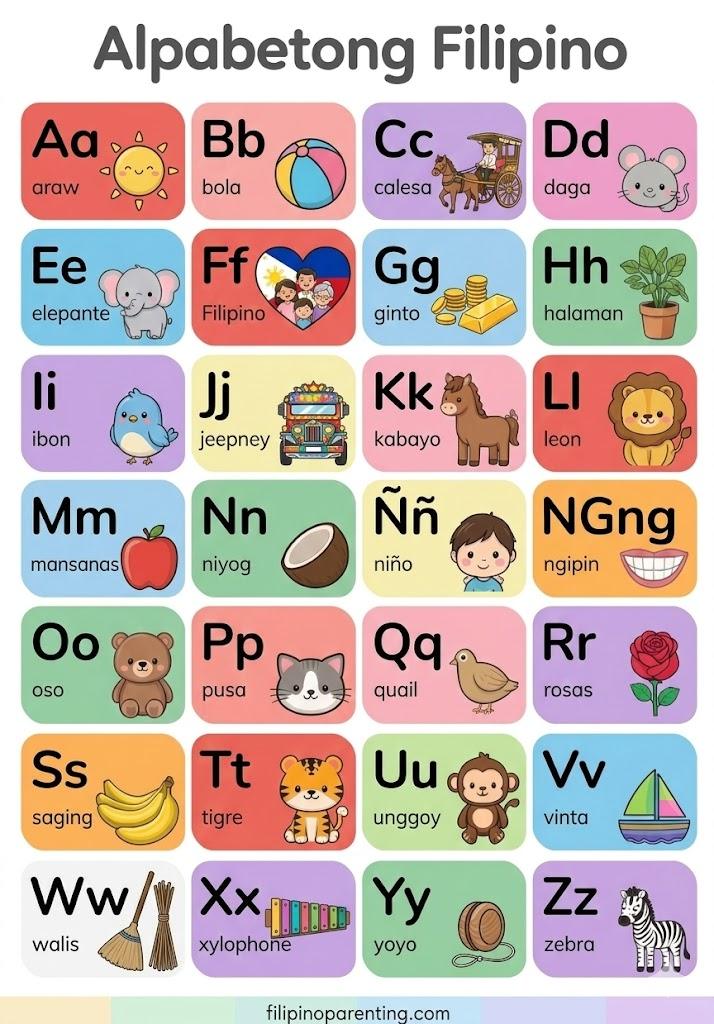
28 Modern Letters: Using Your Free Printable Alpabetong Filipino Chart
If you grew up with the 20-letter Abakada, seeing 28 letters might feel a bit strange at first. But this modern alphabet is a beautiful reflection of who we are today. By using our Free Printable Alpabetong Filipino Chart, you can easily track each letter—from native Tagalog sounds to modern additions. Here is a deep-dive into each letter to help you and your family connect with the language.
Aa is for Araw (Sun)
In Filipino culture, the sun is a symbol of hope. You’ll find it prominently on your Free Printable Alpabetong Filipino Chart. Learning Araw is essential for mastering common greetings like Magandang araw! (Good day!).
Bb is for Bola (Ball)
A simple, everyday object that helps beginners practice the soft “B” sound. Whether it’s basketball in the barangay or a toy at home, the bola is a universal language of fun. If you want to dive deeper into more vocabulary, we have a comprehensive list of Tagalog words that start with the letter B to help you expand your skills. Keeping these additional words in mind while using your Free Printable Alpabetong Filipino Chart is a fantastic way for parents and learners to build confidence in their daily conversations.
Cc is for Calesa (Horse-drawn Carriage)
Real-Talk: We didn’t have the letter ‘C’ in the old Abakada, but it was added to the modern alphabet to honor our history and the languages that shaped us. The Calesa is a beautiful reminder of the cobblestone streets in Vigan and the colonial era. To help the younger generation understand how we traveled before modern cars, explore our detailed guide on the History of the Calesa in the Philippines. This historical icon is a key highlight on our Free Printable Alpabetong Filipino Chart, serving as a bridge between our past and our present.
Dd is for Daga (Mouse)
Practice the dental “Dd” sound here. It’s a common noun found in many Filipino fables and nursery rhymes.
Ee is for Elepante (Elephant)
Elepante is the standard term used to teach the short “E” sound. It helps learners distinguish “E” from “I,” a common hurdle in Tagalog pronunciation.
Ff is for Filipino (Filipino)
This letter allows us to finally spell our identity correctly. Use the Free Printable Alpabetong Filipino Chart to show learners that ‘F’ is now an official part of our national language.
Gg is for Ginto (Gold)
Long before settlers arrived, our ancestors were master goldsmiths, creating intricate jewelry that showcased their skill and wealth. Ginto isn’t just a color; it’s a connection to a thriving pre-colonial history where our people were already brilliant and successful. To explore the deeper meanings and different ways to use this word, see our full guide on Ginto (Gold) in Tagalog. Keeping this historical context in mind while using your Free Printable Alpabetong Filipino Chart helps the younger generation connect with their roots on a deeper level.
Hh is for Halaman (Plant)
For the “Plantitos” and “Plantitas,” Halaman is a staple word that connects us to the lush, tropical greenery of our islands. In Filipino culture, tending to a garden isn’t just a hobby; it’s a way to bring the vibrant life of the province into our modern homes. Practicing the soft, breathy “H” sound with this word is a gentle way for beginners to start their phonetic journey.
To help the younger generation identify the specific flora that makes the Philippines unique—from the fragrant Sampaguita to the sturdy Narra—you can explore our comprehensive guide on Plants in Tagalog. Using this enrichment alongside your Free Printable Alpabetong Filipino Chart allows parents to turn a simple vocabulary lesson into a deeper appreciation for our natural heritage.
Ii is for Ibon (Bird)
From the mighty Philippine Eagle to the humble Maya bird, Ibon represents the spirit of freedom in our culture. When practicing this letter, focus on the sharp, short “I” sound. To help the younger generation connect with this word through art, you can use our Ibon Coloring Pages as a hands-on supplement to your Free Printable Alpabetong Filipino Chart.
Jj is for Jeepney (Jeepney)
The “King of the Road” finally has its own letter in the modern alphabet. More than just a mode of transport, the Jeepney is a vibrant symbol of Filipino creativity, resilience, and community spirit. It’s a cultural icon that you can find right under ‘J’ on your Free Printable Alpabetong Filipino Chart, bridging the gap between traditional sounds and the bustling reality of Philippine streets.
To help the younger generation identify the various ways we navigate our islands, you can explore our full guide on Vehicles in Tagalog. By connecting this high-frequency word to other modes of transportation, parents can turn a simple alphabet lesson into a broader discussion about Filipino innovation and daily life.
Kk is for Kabayo (Horse)
Derived from the Spanish caballo, this word is a classic example of how Tagalog “borrows” and adapts over centuries to stay alive and vibrant. It is one of the most recognizable animals for beginners. To help the younger generation learn about other animals found in the Philippine countryside, pair this lesson with our full list of Tagalog Names for Farm Animals. Using these resources alongside your Free Printable Alpabetong Filipino Chart makes language learning a rich, multi-layered experience for the whole family.
Ll is for Leon (Lion)
While lions aren’t in our jungles, the Leon is a standard vocabulary word for mastering the “L” sound.
Mm is for Mansanas (Apple)
In a Filipino home, mansanas often signals the coming of the Christmas season and the centerpiece of the Noche Buena fruit basket. While apples are an imported fruit, they have become a deeply rooted symbol of celebration and prosperity in our culture. Practicing the “M” sound with this word is a familiar starting point for many learners because of its presence during our most cherished family gatherings.
To help the younger generation distinguish between local favorites and seasonal imports, you can explore our dedicated guide on how to say Apple in Tagalog and its role in Filipino traditions. Integrating these cultural stories alongside your Free Printable Alpabetong Filipino Chart helps parents pass down not just a language, but the “Real-Talk” memories that make our heritage so vibrant.
Nn is for Niyog (Coconut)
The “Tree of Life.” We use every part of the Niyog, from the coconut milk in our cooking to the husks for our floors.
Ññ is for Niño (Child)
This Spanish letter is a nod to our heritage, used most often in proper names and religious traditions like the Santo Niño.
NGng is for Ngipin (Teeth)
Learner’s Tip: On your Free Printable Alpabetong Filipino Chart, this is a single digraph. Practice the nasal sound while you’re brushing your ngipin in the morning!
Oo is for Oso (Bear)
A simple word for practicing the distinct, rounded “O” vowel. It’s an easy-to-remember word for any beginner starting their Tagalog journey. While bears aren’t native to the Philippines, the word is a staple in early language learning. To help the younger generation dive deeper into how we use this word and its cultural context, you can reference our complete guide on Oso (Bear) in Tagalog while using your Free Printable Alpabetong Filipino Chart.
Pp is for Pusa (Cat)
Whether it’s a beloved household pet or a clever pusakal (street cat), Pusa is one of the first words any Filipino family learns. The word itself is short, punchy, and perfect for practicing the unaspirated “P” sound common in Tagalog. In the Philippines, cats are ubiquitous figures in our neighborhoods, often lounging on sari-sari store counters or guarding the barangay alleys.
To help the younger generation understand the nuances of this word—including where the term “pusakal” comes from—explore our deep dive on How to Say Cat in Tagalog. Adding this linguistic enrichment to your Free Printable Alpabetong Filipino Chart gives learners a “Real-Talk” look at how everyday animals shape our daily vocabulary.
Qq is for Quail (Quail)
In Filipino culture, the letter ‘Q’ and the word Quail are inseparable from the iconic street food scene. While the Tagalog word for the bird itself is pugo, we often use the English term when referencing the alphabet. If you have ever enjoyed a stick of kwek-kwek—those deep-fried, orange-battered quail eggs found at every barangay corner—you already have a flavorful connection to this letter.
To help the younger generation explore more feathered friends in our language, you can pair this lesson with our comprehensive guide on Birds in Tagalog and English. Using this enrichment alongside your Free Printable Alpabetong Filipino Chart transforms a simple phonetic exercise into a conversation about Filipino flavors and local wildlife.
Rr is for Rosas (Rose)
Filipino “R” sounds are often trilled or rolled. Use Rosas to practice that vibrant, rolling rhythm that makes Tagalog so melodic. Since roses are most iconic in their blush shades, this is the perfect time to teach the younger generation about the color pink in Tagalog. Using these two words together helps learners build descriptive phrases while using their Free Printable Alpabetong Filipino Chart.
Ss is for Saging (Banana)
From Turon to Banana Cue, the Saging is the ultimate Filipino snack. It’s a high-frequency word for every “Pinay Mom” household, representing the heart of our merienda culture. To learn more about the different varieties we use in our cooking, check out our full guide on Saging (Banana) in Tagalog.
Tt is for Tigre (Tiger)
Practice the hard, sharp “T” sound here. It’s a great way to build confidence in clear Tagalog pronunciation, as the Filipino “T” is dental—meaning the tongue touches the back of the upper teeth—creating a crisp, distinct sound compared to the softer English version. While the Tigre is not a native species to the Philippine archipelago, it is a fixture in global wildlife education and a favorite for learners mastering animal names.
To help the younger generation expand their vocabulary beyond this powerful feline, you can introduce them to other exotic creatures using our guide on Zoo Animals in Tagalog. Using these vivid associations alongside your Free Printable Alpabetong Filipino Chart ensures that pronunciation practice feels like a cultural adventure rather than just a repetitive drill.
Uu is for Unggoy (Monkey)
A playful word that always gets a laugh from the younger generation, Unggoy is a classic vocabulary staple in every Filipino household. Beyond the humor, it serves as an excellent way to practice the rounded “U” sound, which is deeper and more resonant in Tagalog than in English. Whether you are discussing the clever monkeys of our local folklore or observing them in nature, this word is an essential building block for conversational fluency.
To help learners broaden their understanding of the animal kingdom, you can connect this playful term to our detailed guide on Mammals in Tagalog. Referencing this list alongside your Free Printable Alpabetong Filipino Chart allows parents to transition from single-letter recognition to categorizing different species, making the learning process both comprehensive and engaging.
Vv is for Vinta (Traditional Boat)
Cultural Pride: The Vinta represents the seafaring heritage of Mindanao. Its inclusion on the Free Printable Alpabetong Filipino Chart shows that our alphabet belongs to the whole archipelago.
Ww is for Walis (Broom)
The Walis Tambo (indoor) and Walis Tingting (outdoor) are staples in every home. It’s a lesson in tradition and keeping a welcoming space.
Xx is for Xylophone (Xylophone)
While rare in native Tagalog, ‘X’ is necessary for modern literacy and the international loanwords we use today.
Yy is for Yoyo (Yoyo)
Did you know? The modern yoyo was patented by a Filipino-American, Pedro Flores. It’s a piece of our history right there on the Free Printable Alpabetong Filipino Chart.
Zz is for Zebra (Zebra)
The letter ‘Z’ lets us correctly spell regional names like Zamboanga, celebrating the geographical diversity of our homeland.
Mastering the Free Printable Alpabetong Filipino Chart: FAQ
Q: Is the 28-letter alphabet the same as the Abakada? A: No. The traditional Abakada only had 20 letters. The Modern Filipino Alphabet seen on this Free Printable Alpabetong Filipino Chart was modernized to include 8 additional letters.
Q: Where can I hang my Free Printable Alpabetong Filipino Chart? A: We recommend a high-traffic area like the kitchen or a dedicated study corner so that parents and learners can refer to it daily.
3 Tips for Using Your Free Printable Alpabetong Filipino Chart
- Daily Word Association: Pick one letter from the Free Printable Alpabetong Filipino Chart each day. If it’s Nn for Niyog, try making a recipe with coconut milk or Biko.
- National Symbols: Look at Ii for Ibon and discuss our Pambansang Ibon (the Philippine Eagle).
- History Walks: When you see Cc for Calesa on your chart, talk about the history of the Calesa in Vigan.
Download Your Free Printable Alpabetong Filipino Chart
By using this Free Printable Alpabetong Filipino Chart, you aren’t just teaching a language; you are passing down a legacy. This resource is designed to bridge the gap between the traditional Abakada and the modern 28-letter alphabet, ensuring the younger generation remains connected to their roots through every Calesa, Jeepney, and Vinta.
[Download the Full-Resolution PDF Chart Here]
Whether you are a parent living abroad or an adult learner rediscovering your heritage, this chart serves as a daily visual reminder of the beauty and resilience of the Filipino spirit. Pair it with our “Ultimate Guides” to transform a simple vocabulary list into a deep, cultural conversation.