Mammals in Tagalog is translated as mga mamalya.
The word mamalya refers to animals that have fur or hair, give birth to live young, and produce milk to feed their babies. Learning mammals in Tagalog helps expand your vocabulary when talking about animals, wildlife, farms, and nature.
This term is commonly used in science lessons, children’s books, and educational conversations. Understanding it improves both vocabulary and sentence construction in Filipino.
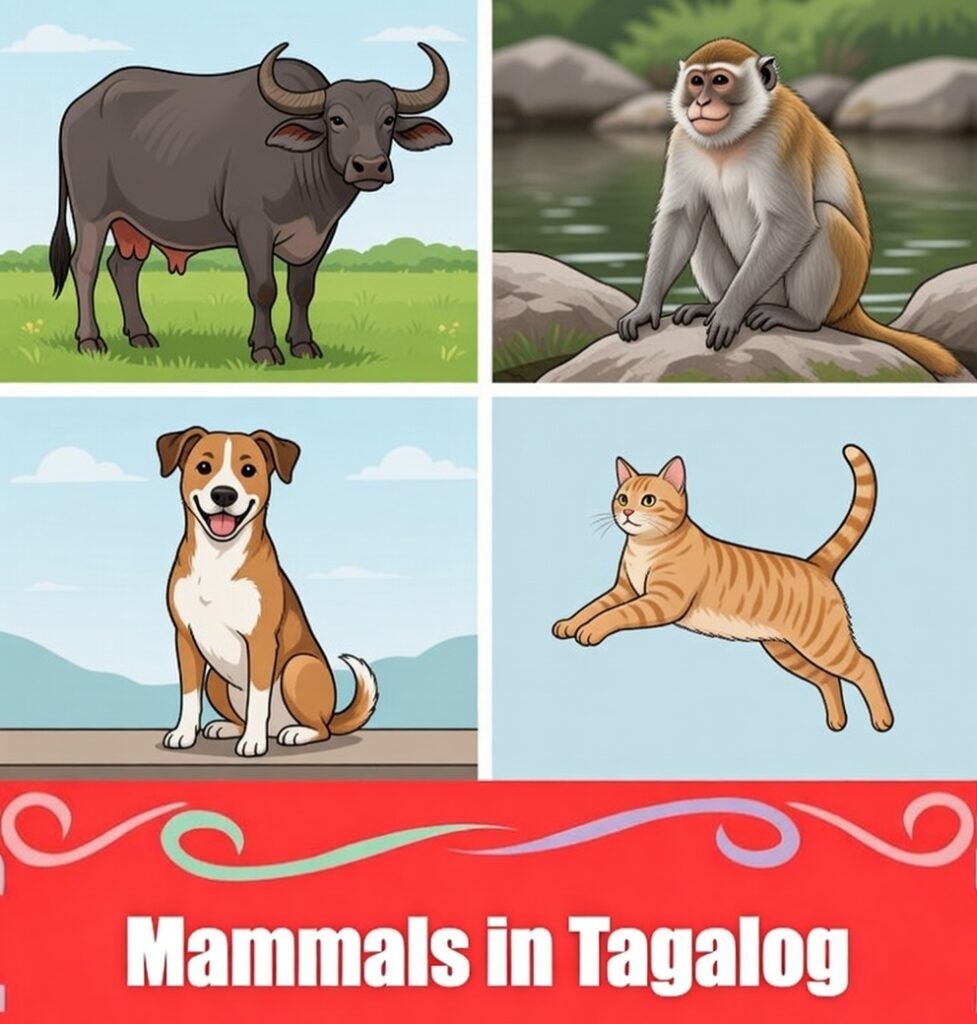
Table of Contents
What are Mammals in Tagalog?
Mammals in Tagalog are called mga mamalya. A mammal is a warm-blooded animal that usually has hair or fur and feeds its young with milk. In Filipino, the singular form is mamalya, while the plural form is mga mamalya.
The term mamalya is used in science and school lessons when classifying animals. It comes from the Spanish word mamífero, which influenced many Filipino scientific terms. Today, mammals in Tagalog is commonly used in biology classes, educational books, and discussions about animals.
Quick Facts
Category: Noun (Science Term)
Used For: Classifying animals
Common Context: School lessons, biology topics, animal discussions
Related Root Word: Mamalya (singular form)
Mammals Vocabulary Words in Tagalog
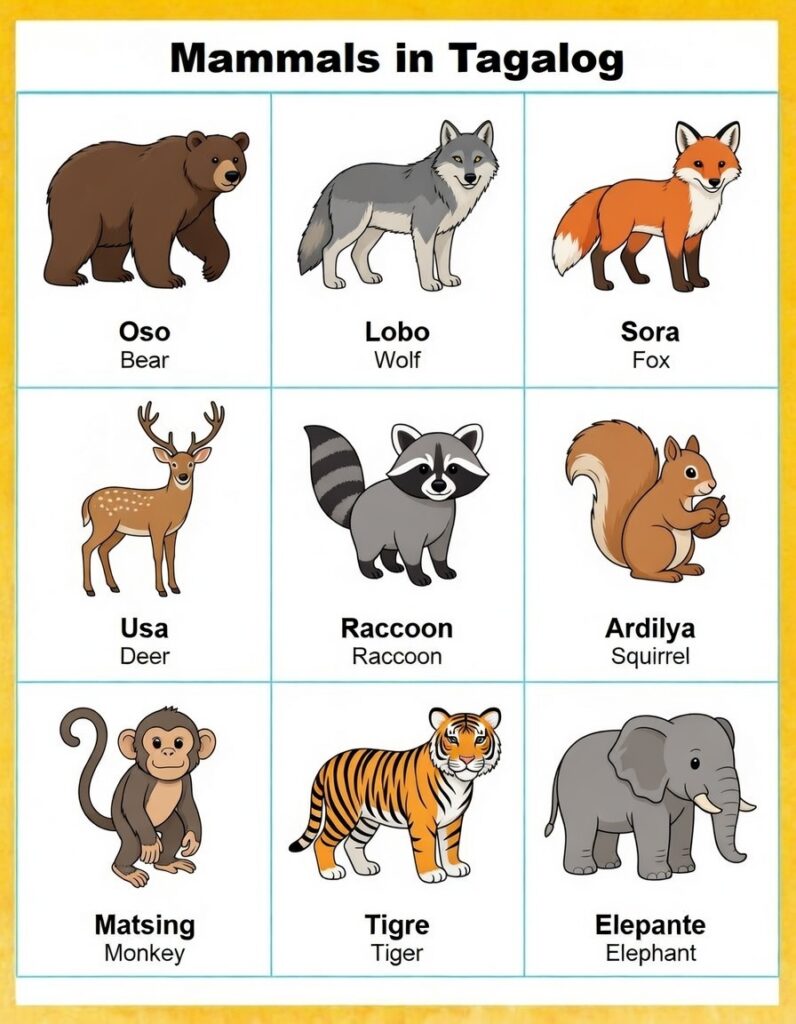
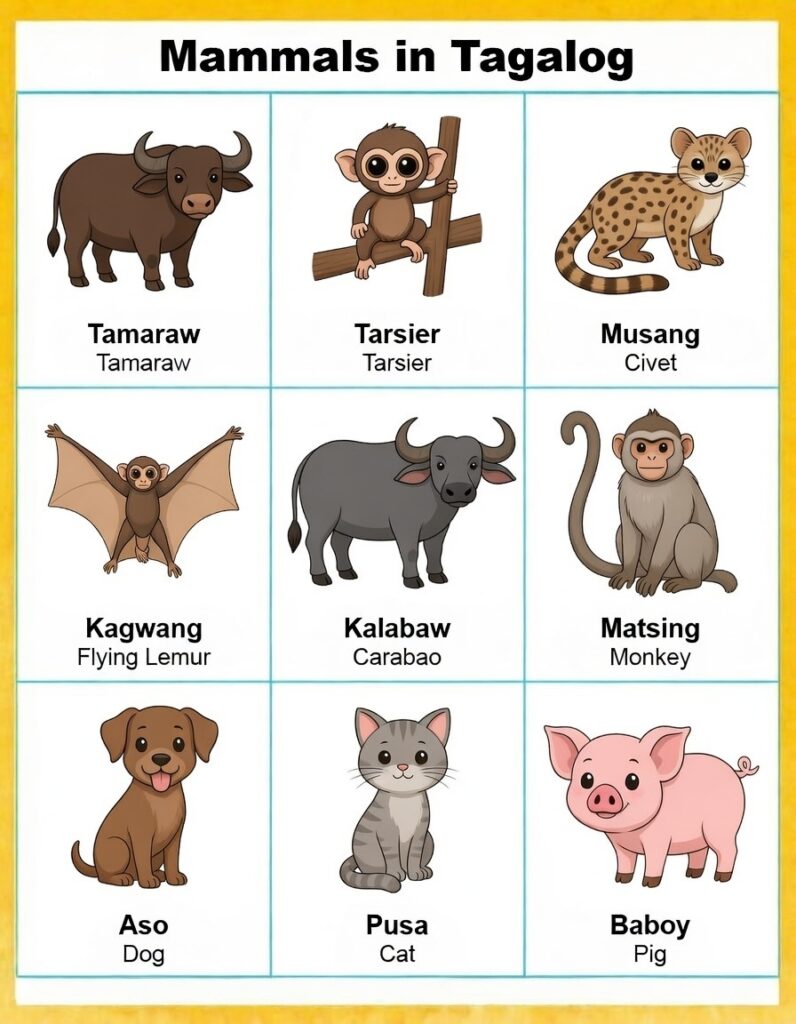
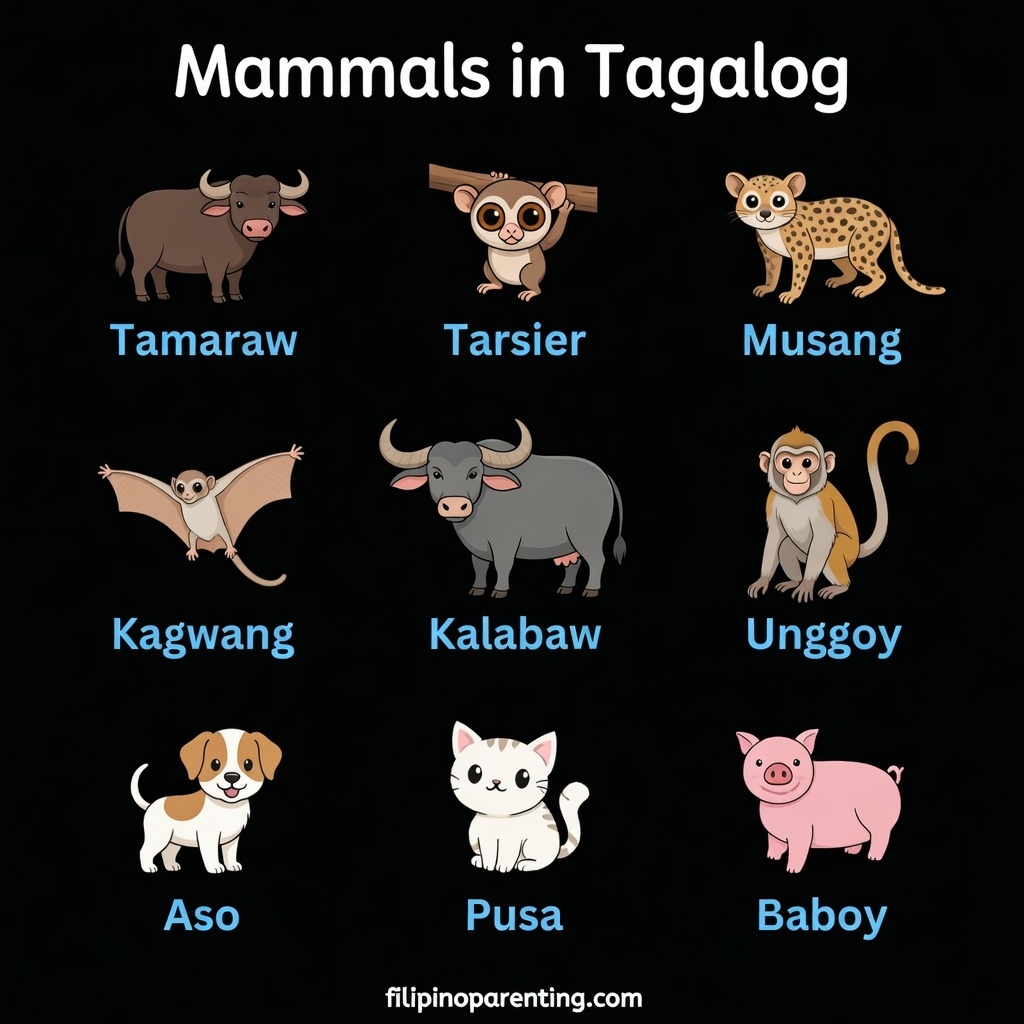
Below is a related vocabulary chart connected to mammals in Tagalog. These commonly used animal names will help you expand your Filipino vocabulary and better understand how mammals are classified and discussed in everyday conversations and school lessons.
| # | English | Tagalog |
|---|---|---|
| 1 | Mammals | Mga Mamalya |
| 2 | Mammal | Mamalya |
| 3 | Dog | Aso |
| 4 | Cat | Pusa |
| 5 | Cow | Baka |
| 6 | Pig | Baboy |
| 7 | Horse | Kabayo |
| 8 | Goat | Kambing |
| 9 | Sheep | Tupa |
| 10 | Rabbit | Kuneho |
| 11 | Deer | Usa |
| 12 | Elephant | Elepante |
| 13 | Lion | Leon |
| 14 | Tiger | Tigre |
| 15 | Monkey | Unggoy o Matsing |
| 16 | Gorilla | Gorilya |
| 17 | Wolf | Lobo |
| 18 | Fox | Sora (babae) / Soro (lalaki) |
| 19 | Bat | Paniki |
| 20 | Bear | Oso |
Learning these mammals in Tagalog helps improve animal vocabulary, strengthen sentence construction, and support science learning in Filipino. By practicing these words regularly, you can confidently describe pets, farm animals, and wild mammals in Tagalog conversations.
How Is Mammals Used in Tagalog?
The term mammals in Tagalog (mga mamalya) is commonly used in educational, scientific, and descriptive contexts. It helps classify animals and explain their characteristics clearly.
1. In Science and Education
The word mamalya is frequently used in biology lessons and classroom discussions when teaching students how animals are grouped.
Examples:
Ang aso ay isang mamalya.
(The dog is a mammal.)
Ang elepante ay malaking mamalya.
(The elephant is a large mammal.)
Ang paniki ay mamalya kahit ito ay lumilipad.
(The bat is a mammal even though it flies.)
Using the term mammals in Tagalog helps students understand animal classification and strengthens science vocabulary in Filipino.
2. In Descriptive Conversations
People use mammals in Tagalog (mga mamalya) when talking about animals in general or describing wildlife.
Examples:
Maraming mamalya sa gubat.
(There are many mammals in the forest.)
Ang mga mamalya ay may balahibo.
(Mammals have fur or hair.)
Using the term in everyday conversations allows broader discussions about wildlife, nature, and animal characteristics in Tagalog.
3. In Storytelling
The word mammals in Tagalog (mga mamalya) often appears in children’s books, school reading materials, and educational storytelling. Writers and teachers use it to describe animals while explaining their characteristics in a simple and engaging way.
In stories, characters may be identified as mammals to highlight traits such as having fur, caring for their young, or living in forests and farms. This helps children understand animal classification while enjoying imaginative narratives.
Using mamalya in storytelling makes science concepts easier to understand and connects learning with creativity and language development.
4. In Farming Contexts
The term mammals in Tagalog (mga mamalya) is also used when discussing farm animals. Many animals raised on farms are mammals because they produce milk and give birth to live young.
Examples:
Ang baka ay mamalya na nagbibigay ng gatas.
(The cow is a mammal that gives milk.)
Ang kambing ay kabilang sa mga mamalya.
(The goat belongs to the group of mammals.)
Using the word mamalya in farming contexts helps explain animal classification while discussing agriculture, livestock, and food sources in Tagalog.
5. In Wildlife Discussions
The term mammals in Tagalog (mga mamalya) is commonly used when describing wild animals found in forests, mountains, or zoos. It helps identify and classify animals based on their biological characteristics.
Examples:
Ang leon ay mabangis na mamalya.
(The lion is a fierce mammal.)
Ang usa ay mamalya na matatagpuan sa kagubatan.
(The deer is a mammal found in the forest.)
Using mamalya in wildlife discussions helps people clearly describe animals in nature while improving vocabulary related to forests, zoos, and environmental topics in Tagalog.
Importance and Practical Value of Mammals
Learning the word has practical value in communication and education.
1. Communication Benefit
It helps describe animals accurately.
2. Cultural Relevance
Animals play a role in Filipino farming and storytelling traditions.
3. Learning Advantage
It strengthens science vocabulary in Tagalog.
4. Practical Everyday Use
It is useful when discussing pets, farms, and wildlife.
5. Social or Emotional Impact
It improves confidence when speaking about animals.
6. Professional or Academic Value
It is important in biology classes and academic writing.
How to Use Mammals in Daily Life
You can practice using mammals in Tagalog (mga mamalya) in simple, everyday conversations and learning activities.
Describe animals during school lessons when discussing science topics or classification.
Use the word while teaching children about pets, farm animals, and wildlife to strengthen their vocabulary.
Form sentences using mga mamalya to practice plural construction in Tagalog.
Compare mammals with birds or reptiles to better understand animal differences and characteristics.
Write short paragraphs about animals and identify which ones are mammals.
Practicing these simple activities helps improve vocabulary, sentence structure, and confidence when discussing mammals in Tagalog in both academic and casual settings.
Commonly Used Example Phrases in Tagalog
Below are commonly used sentences with mammals.
The dog is a mammal.
Ang aso ay isang mamalya.
Cats are mammals.
Ang mga pusa ay mga mamalya.
A whale is a mammal.
Ang balyena ay mamalya.
The lion is a wild mammal.
Ang leon ay mabangis na mamalya.
Bats are mammals.
Ang mga paniki ay mga mamalya.
Cows are farm mammals.
Ang mga baka ay mamalya sa bukid.
A monkey is an intelligent mammal.
Ang unggoy ay matalinong mamalya.
Humans are mammals.
Ang tao ay mamalya.
The elephant is a large mammal.
Ang elepante ay malaking mamalya.
Many mammals live in the forest.
Maraming mamalya ang nakatira sa gubat.
Frequently Asked Questions (FAQ)
1. What is mammals in Tagalog?
Mammals in Tagalog is mga mamalya.
2. What does mammals mean in English/Tagalog?
It refers to animals that have hair or fur and produce milk for their young.
3. Is mammals formal or informal?
It is commonly used in educational and formal contexts.
4. When should you use mammals?
Use it when classifying or describing animals in science or conversation.
5. How do you properly use mammals in a sentence?
Use mamalya for singular and mga mamalya for plural forms.
Conclusion
Mammals in Tagalog is translated as mga mamalya, referring to animals that produce milk and usually have fur or hair. It is an important scientific term used in education and everyday discussions about animals.
Learning this word improves vocabulary, strengthens sentence construction, and builds confidence when speaking Filipino in both academic and casual settings.