If you’re looking for a way to get the family outside while sneaking in some language learning, this Filipino Wildlife Scavenger Hunt is the perfect solution. This fun outdoor activity combines nature exploration with Tagalog vocabulary practice, turning an ordinary backyard walk into an engaging language lesson.
Instead of just “looking for bugs,” learners identify animals and insects using Filipino words—making this both a nature exploration and a heritage language activity.
This printable Filipino scavenger hunt is ideal for:
- Filipino families living abroad (heritage learners)
- Parents teaching Tagalog at home
- Homeschoolers exploring Southeast Asian culture
- Adult beginners looking for hands-on Tagalog practice
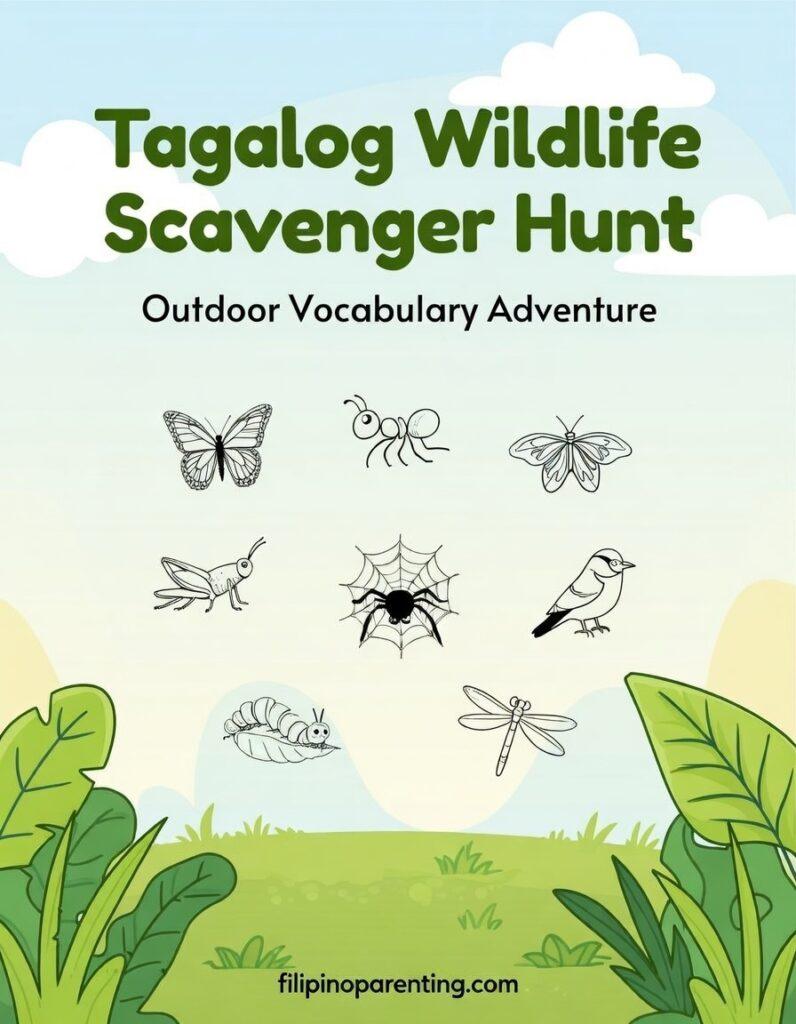
Table of Contents
🌱 Why This Filipino Wildlife Scavenger Hunt Works
Traditional vocabulary drills can feel repetitive.
But spotting a langgam (ant) crawling across a brick or watching a paruparo (butterfly) land on a flower during your outdoor scavenger hunt creates a lasting memory.
When learners connect real-world experiences to Tagalog words, vocabulary retention improves naturally.
This activity supports:
- Outdoor learning
- Filipino language development
- Cultural connection
- Active memory recall
Movement + observation + repetition = better long-term retention.
🐜 Tagalog Wildlife Vocabulary List for Your Scavenger Hunt
Here’s your essential Filipino wildlife vocabulary list. Each word includes the Tagalog term, English meaning, and a simple real-life note.
- Paruparo (Butterfly): Common in gardens and around flowers.
- Langgam (Ant): Often seen walking in lines along the ground.
- Gamu-gamo (Moth): Usually found near lights at night.
- Tipaklong (Grasshopper): Jumps quickly in grassy areas.
- Gagamba (Spider): Builds webs in corners and plants.
- Ibon (Bird): Look for them in trees or on rooftops.
- Uod (Caterpillar): Often found on leaves and garden plants.
- Tutubi (Dragonfly): Flies near water and open spaces.
These are common nature words in Tagalog that children are likely to encounter outdoors.
🎯 How to Run Your Filipino Wildlife Scavenger Hunt
Download the Printable
Scroll to the bottom of this post to download your FREE Filipino Wildlife Scavenger Hunt printable PDF.
Print it out and bring a pencil or crayons to check off each item.
Use the “Check and Repeat” Rule
To complete each item, the learner must say the Tagalog word aloud three times.
This strengthens pronunciation and builds confidence in speaking Filipino.
Create a Nature Album
Take photos of each item you find during your nature walk.
Later, review the photos and label them with the correct Tagalog spelling. This turns your scavenger hunt into a mini Filipino vocabulary review session.
Try Simple Sentence Practice
Encourage learners to build short Tagalog sentences such as:
Nakita ko ang langgam sa lupa.
(I saw the ant on the ground.)
Even one sentence per item helps reinforce Filipino sentence structure and vocabulary.
🌞 Bonus: The Sensory Hunt (Tagalog Adjectives for Kids)
Expand your Filipino language learning by finding items that are:
- Malambot (Soft)
- Matigas (Hard)
- Matinik (Spiky)
This adds descriptive vocabulary to your Tagalog scavenger hunt and encourages deeper observation.
💡 FAQ: Filipino Wildlife & Tagalog Vocabulary
Is it “Paru-paro” or “Paruparo”?
According to the Komisyon sa Wikang Filipino, the modern standard spelling is paruparo (without a hyphen). Both forms are commonly used, but paruparo follows current Filipino language standards.
What if we can’t find a tutubi?
Nature doesn’t always cooperate — and that’s part of outdoor learning. Use it as a chance to discuss where dragonflies live and when they are most active.
🌿 Conclusion: Turn Nature Into a Filipino Language Classroom
A Filipino Wildlife Scavenger Hunt is more than just a kids’ outdoor activity.
It’s a simple way to practice Tagalog vocabulary, encourage bilingual development, and strengthen cultural identity — all while getting fresh air.
By combining nature exploration with Filipino language learning, you transform a regular walk into an immersive educational experience.
Ready to begin?
Download and print your Filipino Wildlife Scavenger Hunt worksheet, head outside, and start building Tagalog vocabulary through real-world discovery.