Understanding how to express feelings is a core part of mastering the language and connecting deeply with Filipino culture. Whether you are a beginner or a parent teaching the younger generation, having a reliable Emotions Vocabulary Word List in Tagalog is essential for “real-talk” conversations.
In Tagalog, the word for emotions is mga damdamin. These words describe our internal state—happiness, sadness, anger, excitement, and fear. Filipino culture encourages expressing these feelings openly, and this guide provides the ultimate Emotions Vocabulary Word List in Tagalog to help you navigate daily life, stories, and family heart-to-hearts.
Below is your complete guide, categorized into Positive, Negative, and Physical/Reactive states, featuring English translations and practical example sentences.
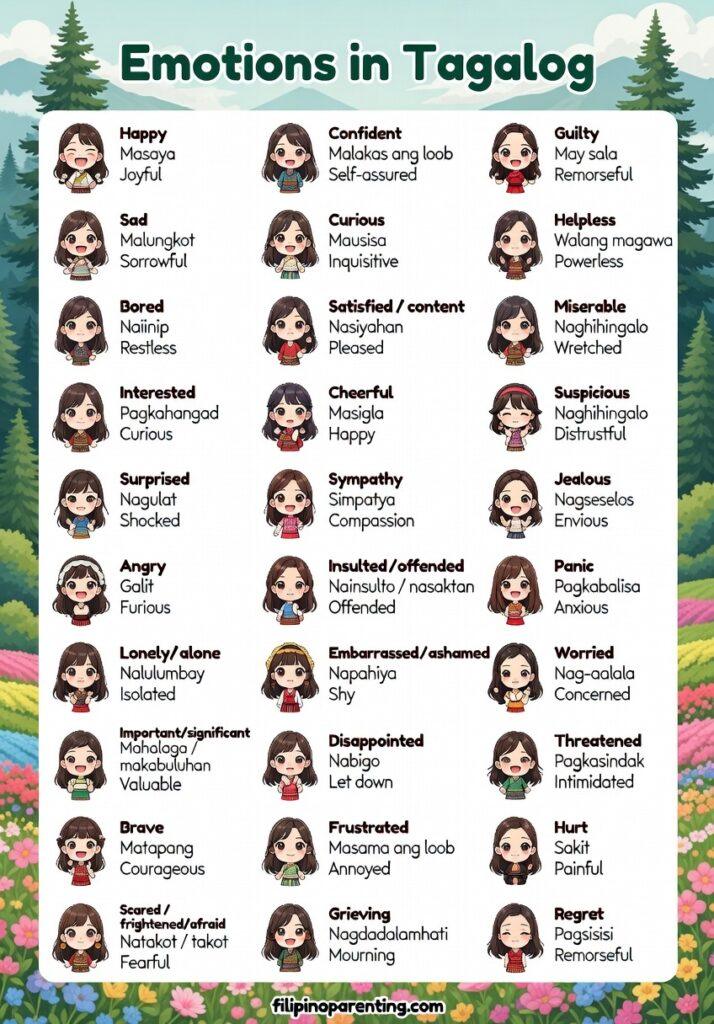
Table of Contents
Positive Emotions: Your Vocabulary Word List in Tagalog (Masayang Damdamin)
These terms describe the happy, pleasant, or uplifting feelings often celebrated in Filipino households. Using an Emotions Vocabulary Word List in Tagalog helps learners distinguish between simple “happiness” and deep “pride” or “gratitude.”
| Tagalog | English | Context/Usage |
| Masaya | Happy | The most common word for joy in any Emotions Vocabulary Word List in Tagalog. |
| Tuwang-tuwa | Very Happy / Delighted | Extreme happiness, often used during celebrations. |
| Nasasabik | Excited | Feeling eager or looking forward to something special. |
| Kalmado | Calm | A peaceful and relaxed state of mind. |
| Kuntento | Content / Satisfied | Feeling at ease with what one has (Spanish-derived). |
| Nagpapasalamat | Grateful | Expressing gratitude or being “thankful.” |
| Ipinagmamalaki | Proud | Often used by parents to celebrate the younger generation’s achievements. |
Fascinating Facts: The Spirit of “Tuwa” vs. “Saya”
In a “Real-Talk” cultural context, saya is often a general state of happiness, whereas tuwa is an outward, bubbly delight. When you tell a beginner to use this Emotions Vocabulary Word List in Tagalog, remind them that Filipinos love expressing tuwa through shared laughter (tawanan) and food!
Example Sentences for Practice
- Ipinagmamalaki kita. — I am proud of you. (A must-know for every Pinay Mom!)
- Nasasabik siya sa kanyang kaarawan. — She is excited about her birthday.
- Kalmado ang pakiramdam ko ngayon. — I feel calm today.
- Masaya ako ngayon. — I am happy today.
Negative or Difficult Emotions: A Vocabulary Word List in Tagalog
In Filipino culture, understanding “heavy” feelings is the first step toward Pakikiramay—the act of sharing in another person’s sorrow or burden. This Emotions Vocabulary Word List in Tagalog focuses on identifying difficult emotions so we can better support our families and the younger generation.
| Tagalog | English | Context/Usage |
| Malungkot | Sad | The standard term for sadness in any Emotions Vocabulary Word List in Tagalog. |
| Nalulungkot | Feeling Sad | Describes the ongoing state of experiencing sadness. |
| Galit | Angry | Strong displeasure, ranging from annoyance to rage. |
| Takot | Afraid / Scared | A state of fear or anxiety. |
| Nahihiya | Shy / Embarrassed | Tied to the deep cultural concept of Hiya (shame/propriety). |
| Nag-aalala | Worried | Constant concern, often felt by parents for their household. |
| Nasasaktan | Hurting | Used for both physical pain and emotional heartbreak. |
Real-Talk: Understanding “Hiya”
When using this Emotions Vocabulary Word List in Tagalog, beginners should pay special attention to Nahihiya. In the West, “shy” is just a personality trait. In the Philippines, Hiya is a social glue—it’s about not wanting to lose face or cause a scene. It’s a “Fascinating Fact” that many learners find most challenging!
Example Sentences for Connection
- Huwag kang mahiya. — Don’t be shy/embarrassed.
- Malungkot siya dahil umalis ang kaibigan niya. — She is sad because her friend left.
- Nawawalan siya ng pag-asa sa sitwasyon. — He feels hopeless about the situation.
- Nasasaktan ang damdamin ko. — My feelings are hurt.
Angry Emotions: Vocabulary Word List in Tagalog (Galit na Damdamin)
These terms describe varying levels of anger, irritation, or frustration. In Filipino culture, being aware of “pikon” or “inis” is key to smooth social interactions. Use this Emotions Vocabulary Word List in Tagalog to identify the intensity of the feeling.
| Tagalog | English | Context/Usage |
| Galit | Angry | The general term for anger in any Emotions Vocabulary Word List in Tagalog. |
| Inis | Annoyed | A mild irritation, often caused by small inconveniences. |
| Yamot | Irritated | A deeper sense of frustration or being “fed up.” |
| Nagagalit | Getting Angry | The active process of becoming upset. |
| Pikon | Easily Offended | A “Fascinating Fact” word for someone who can’t take a joke or teasing. |
Fascinating Fact: What is a “Pikon”?
In Filipino culture, “biruan” (teasing) is a way of life. If someone gets angry or takes the joke too seriously, they are called Pikon. Adding this to your Emotions Vocabulary Word List in Tagalog is essential because it describes a specific personality trait often discussed in Pinay households!
Example Sentences for Real-Talk
- Huwag kang pikon! — Don’t be so sensitive/easily offended!
- Galit siya sa nangyari. — He is angry about what happened.
- Naiinis ako sa ingay. — I am annoyed by the noise.
- Nagagalit siya kapag hindi siya pinapakinggan. — She gets angry when no one listens to her.
Fear and Worry: Vocabulary Word List in Tagalog (Takot at Pag-aalala)
Fear and worry are natural responses to the unknown. Whether it is a beginner’s first time speaking the language or a parent’s concern for their family’s safety, this Emotions Vocabulary Word List in Tagalog provides the specific terms needed to describe these uneasy feelings.
| Tagalog | English | Context/Usage |
| Takot | Afraid | The basic root word for fear in any Emotions Vocabulary Word List in Tagalog. |
| Natatakot | Scared | Actively experiencing fear in the moment. |
| Kaba | Nervous | That “fluttery” or heavy feeling in the chest before an event. |
| Nag-aalala | Worried | A deep sense of concern for oneself or loved ones. |
| Balisa | Anxious | A restless or uneasy state of mind where one cannot stay still. |
Fascinating Fact: The Feeling of “Kaba”
In a “Real-Talk” context, Filipinos often describe nervousness as having kaba sa dibdib (nervousness in the chest). It is more than just being “anxious”—it is a physical sensation of the heart racing. Adding this nuance to your Emotions Vocabulary Word List in Tagalog helps the younger generation understand the physical side of their feelings.
Example Sentences for Real-Life Use
- Bakit ka balisa? — Why are you anxious/restless?
- Natatakot ang mag-aaral sa dilim. — The learner is afraid of the dark.
- May kaba siya bago ang pagsusulit. — He feels nervous before the exam.
- Nag-aalala ako sa aking pamilya. — I am worried about my family.
Physical & Reactive States: Vocabulary Word List in Tagalog (Mga Pisikal at Reaktibong Damdamin)
These terms describe bodily or immediate reactions to our environment. In a “Real-Talk” Filipino household, these are the most common words you’ll hear daily. Use this Emotions Vocabulary Word List in Tagalog to help beginners and the younger generation communicate their physical needs and social reactions.
| Tagalog | English | Context/Usage |
| Pagod | Tired | Physical exhaustion after a long day of work or chores. |
| Gulat | Surprised / Shocked | A sudden reaction to something unexpected in any Emotions Vocabulary Word List in Tagalog. |
| Nasasaktan | Hurting / In Pain | Can refer to physical pain (like a scrape) or emotional hurt. |
| Inaantok | Sleepy | Specifically feeling drowsy and ready for bed. |
| Hiya | Shy / Embarrassed | Feeling self-conscious or wanting to avoid attention. |
| Naiinggit | Jealous | Feeling envy toward another’s success or advantage. |
Fascinating Fact: The Difference Between “Pagod” and “Hapo”
While Pagod is the standard term, you might also hear the word Hapo. Hapo is a deeper level of exhaustion—being “spent” or “breathless.” For the “Pinay Mom” who does it all, knowing these distinctions helps you express exactly how you feel at the end of a busy day!
Example Sentences for Daily Practice
- Inaantok na ang mga bata. — The younger kids are already sleepy.
- Nagulat ako sa balita. — I was surprised by the news.
- Nahihiya siya magsalita sa harap ng klase. — She feels shy speaking in front of the class.
- Pagod ako pagkatapos ng trabaho. — I am tired after work.
Common Emotion Phrases in Tagalog
These are useful for everyday conversation.
| Tagalog | English |
| Kumusta ang pakiramdam mo? | How do you feel? |
| Masaya ako | I am happy. |
| Nalulungkot ako | I feel sad. |
| Natatakot ako | I am afraid. |
| Nag-aalala ako | I am worried. |
FAQ: Emotions Vocabulary Word List in Tagalog (Mga Damdamin)
1. What does mga damdamin mean in English? Answer: Mga damdamin is the Tagalog word for emotions or feelings. It refers to how a person experiences happiness, sadness, anger, fear, and other emotional states.
2. How do I express that I am happy in Tagalog? Answer: You can say “Masaya ako” (I am happy) or “Tuwang-tuwa ako” (I am very happy / delighted).
3. What are some common Tagalog words for sadness? Answer: Common terms in our Emotions Vocabulary Word List in Tagalog include:
- Malungkot – Sad
- Nalulungkot – Feeling Sad
- Nag-iisa – Lonely
- Nasasaktan – Hurt
- Bigo – Disappointed
- Example: Malungkot siya dahil umalis ang kaibigan niya. — She is sad because her friend left.
4. How do I say “I am afraid” or “scared” in Tagalog? Answer: Use “Natatakot ako” (I am afraid/scared). For nervousness, especially that feeling in your chest, you can say “May kaba ako.”
5. How do Filipinos express anger in Tagalog? Answer: Some essential “Real-Talk” words include:
- Galit – Angry
- Inis – Annoyed
- Yamot – Irritated
- Pikon – Easily offended
- Example: Nagagalit siya kapag hindi siya pinapakinggan. — She gets angry when no one listens to her.
6. What are some physical or reactive emotions in Tagalog? Answer: These describe bodily reactions or immediate responses:
- Pagod – tired
- Gulat – Ssurprised/Sshocked
- Inaantok – Sleepy
- Hiya – Shy/Embarrassed
7. How can I ask someone how they are feeling in Tagalog? Answer: Say “Kumusta ang pakiramdam mo?” — How do you feel?
8. Why is it important to learn this Emotions Vocabulary Word List in Tagalog? Answer: Understanding these terms helps build strong connections with Filipino family, improves cultural understanding, and allows you to communicate feelings accurately in daily conversations and “Real-Talk” heart-to-hearts.
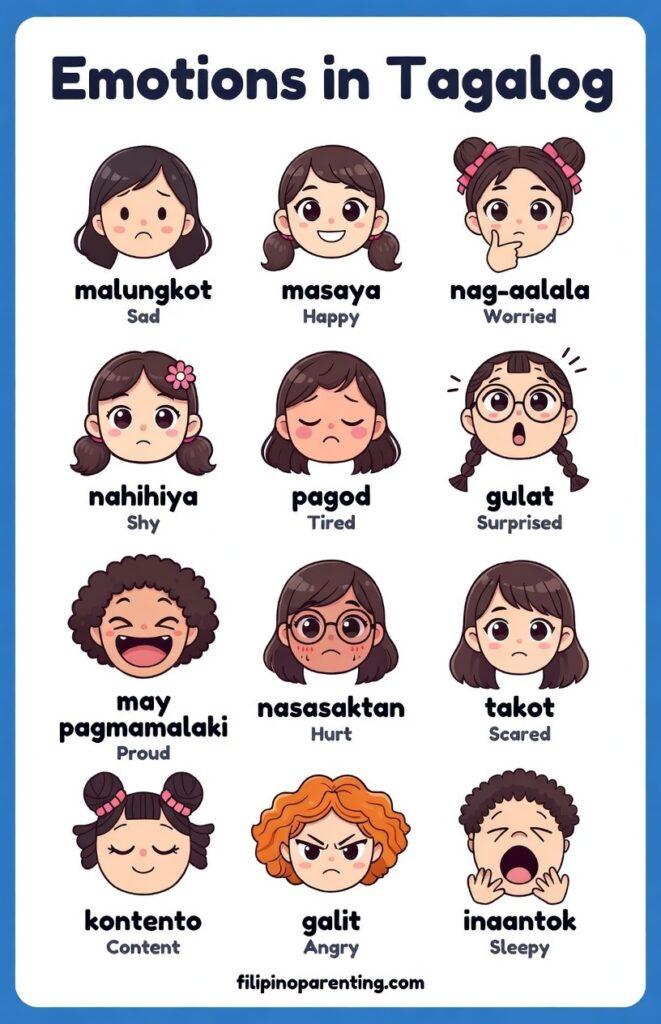
Master the heart of the language. Use this comprehensive Emotions Vocabulary Word List in Tagalog to express everything from common joy to deep cultural pride.
Emotions Vocabulary Word List in Tagalog: Free PDF Guide
Take Your Learning to the Next Level! To help you and the younger generation practice these mga damdamin during your family heart-to-hearts, I’ve created a high-quality educational resource just for you.
Download the Ultimate Emotions Vocabulary Word List in Tagalog PDF Here
Tip: Print this out and keep it on your fridge for quick “Real-Talk” check-ins with the family!
Conclusion: Mastering Your Emotions Vocabulary Word List in Tagalog
Understanding emotions in Tagalog (mga damdamin) is more than memorizing words—it’s about connecting deeply with Filipino culture, expressing yourself authentically, and building meaningful relationships. By learning positive, negative, and physical/reactive emotions, you can communicate feelings clearly in daily life and stories.
Start with simple phrases like “Masaya ako” (I am happy) or “Nag-aalala ako” (I am worried), and gradually explore deeper cultural concepts like Hiya (shy/embarrassed) or kaba (nervous). The more you practice, the easier it becomes to express yourself naturally in Tagalog.
Whether you’re a parent teaching the younger generation, a beginner learning the language, or an adult reconnecting with your roots, mastering this Emotions Vocabulary Word List in Tagalog helps you understand yourself and others better.
Pinay Mom Tip: Keep this guide handy and review it often! Recognizing and expressing emotions in Tagalog will strengthen both your language skills and your cultural bonds.