Tagalog words starting with I are foundational for anyone looking to master the natural sounds of the Filipino language. The letter I—pronounced as a short “Ee”—brings to life many words related to nature, family, and daily actions. Whether you are a parent teaching the younger generation or an adult learner, understanding these terms will significantly improve your fluency and cultural connection.
In this guide, we explore a verified list of words that are common in every Filipino household. By focusing on these Tagalog words starting with I, you can build a strong vocabulary and start forming simple sentences today.
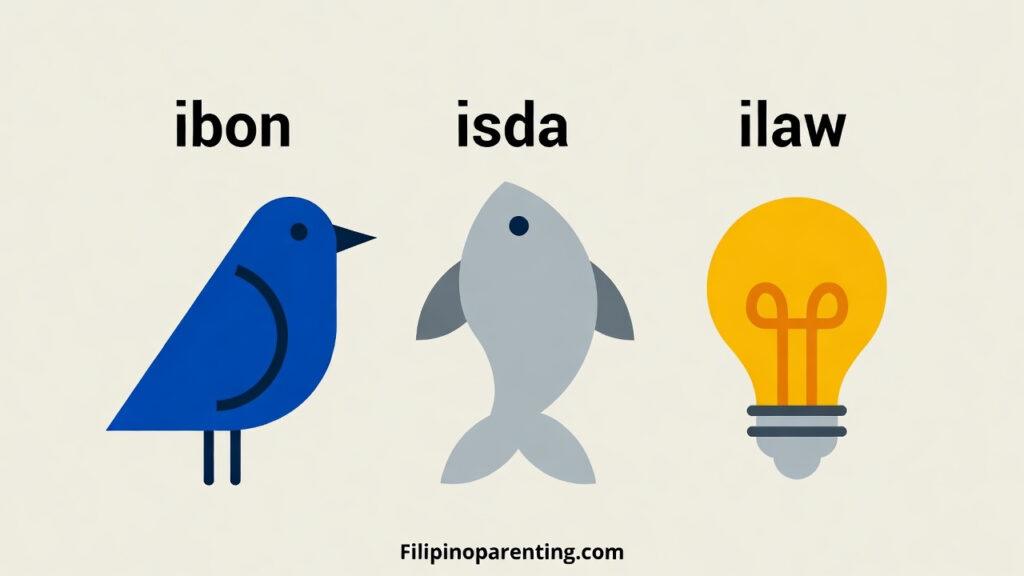
Table of Contents
Nature and Animals Using the Letter I
The natural world provides some of the most common vocabulary for beginners. In the Philippines, you will often hear these words when describing the environment or local wildlife. Next time you see a bird outside, point and say “Ibon!” with your family—it is an easy, joyful way to start your immersion.
- Ibon (EE-bon) – Bird
- Ilog (EE-log) – River
- Isda (EES-dah) – Fish
- Itlog (IT-log) – Egg
- Ipis (EE-pis) – Cockroach
Teaching these Tagalog words starting with I to families is easy because they are very visual. For instance, you can point to a bird in the sky or look at a river during a trip and call it “Ilog.” For more fun ways to engage with nature, you can check out our Filipino wildlife scavenger hunt or see how our ibon coloring pages can help with word recognition.
Common Objects and Actions
Beyond nature, Tagalog words starting with I cover many items you interact with daily. From the kitchen to the bedroom, these terms are part of the rhythm of Filipino life.
- Ilaw (EE-law) – Light/Lamp
- Inom (EE-nom) – To drink
- Ingat (EEN-gat) – Take care
- Ihaw (EE-haw) – To grill
- Iwan (EE-wan) – To leave behind
- Init (EE-nit) – Heat or hot
When you say “Ingat ka!” to a loved one, you are expressing a deep cultural value of protection and care. It is one of the beautiful Tagalog words because of the emotion it carries. If you are learning about household settings, it is helpful to know how to describe household items in Tagalog to navigate a Filipino home comfortably.
People and Relationships
Building a vocabulary for relationships is vital for connecting with your heritage. The letter I starts some of the most important words for identity and family connection in the Philippines.
- Ina (ee-NAH) – Mother (While Nanay is more casual, Ina is beautiful and poetic)
- Inaanak (ee-NAH-ah-nak) – Godchild
- Irog (EE-rog) – Beloved/Dear
- Inapo (ee-NAH-poh) – Great-grandchild
- Ikaw (EE-kow) – You
- Iba (ee-BAH) – Other or Different
Understanding these roles helps learners participate in family traditions. For example, knowing the term for a godchild is important during celebrations. You can find more about these connections in our guide on family in Tagalog. If it happens to be a special day for a family member, you might want to learn how to say maligayang kaarawan inaanak to show your affection.
Mastering the Pronunciation
The “I” in Tagalog is consistent, unlike in English where it can change sounds based on the word. It always sounds like the “ee” in “feet” or “keep.” Practice saying “Isda” (Ees-dah) or “Ilog” (Ee-log) to get the hang of the vowel sound.
To ensure your accent is accurate and clear, you can study formal resources such as the Tagalog.com Dictionary or the linguistic archives at the University of Hawaii SEASite. These tools provide deeper study into the Filipino language.
Example Sentences for Practice
To truly learn these Tagalog words starting with I, you must see them in action. Here are simple sentences to help you practice using them in your daily life:
- Ang ibon ay lumilipad. – The bird is flying.
- Malinis ang ilog. – The river is clean.
- Kumain tayo ng isda. – Let’s eat fish.
- Buksan mo ang ilaw. – Turn on the light.
- Uminom ka ng tubig. – Drink some water.
FAQ: Learning the Letter I
What is the most common I word in Tagalog?
“Ikaw” (You) and “Inom” (To drink) are used very frequently in daily conversation between friends and family.
What’s a fun word for affection starting with I?
“Irog”—you can use it to say “Irog ko” (my beloved) to someone special!
Why focus on the letter I?
Many essential family terms and daily verbs begin with I, making it a high-value letter for beginners and families to master early on.
Is the “I” sound always the same?
Yes, in the Filipino alphabet, the “I” sound is a consistent “Ee” sound.
How do I say “to grill” in Tagalog?
The root word is “Ihaw,” which is used when preparing favorite Filipino BBQ dishes.
Conclusion: Exploring Tagalog Words Starting with I
Exploring Tagalog words starting with I is a fantastic way to broaden your understanding of Filipino culture. Pick one word today—say “Ingat ka!” to a loved one or label your favorite ilaw—and watch your confidence grow. By focusing on these 10+ amazing words, you are building the blocks for better communication.
Keep practicing, stay curious, and enjoy your Tagalog journey. Understanding these terms helps keep our vibrant heritage alive for the younger generation. Maraming salamat for joining this lesson!