Science in Tagalog, commonly known as Agham or Siyensya, is the systematic study of the natural world through observation, experimentation, and analysis. These science terms in Tagalog are widely used in schools, textbooks, research, and everyday explanations about nature, health, weather, and technology.
Historically, science in Tagalog developed through translation, adaptation, and word-coining. This process blends native Filipino roots with Spanish-derived and Filipinized English terms, allowing complex scientific ideas to be expressed clearly and practically in Filipino.
Table of Contents
Quick Facts About Science in Tagalog
- Category: Concept / Academic subject
- Tagalog Terms for Science: Siyensya, Agham
- Used For: School subjects, research, scientific explanations, natural phenomena
- Common Context: Education, weather, biology, physics, chemistry
- Related Root Word: Saliksik (to investigate)

Science Vocabulary Words in Tagalog (Grouped by Type)
Learning science vocabulary in Tagalog becomes easier when terms are grouped by field. Below are the most commonly used Tagalog science words by category.
1. General Science Terms (Agham at Paraang Siyentipiko)
These foundational terms describe science in Tagalog, scientists, and the scientific method. They are essential for classroom discussions, textbooks, research papers, and basic explanations of how scientific knowledge is formed.
Learning these general science terms in Tagalog provides a strong foundation for understanding biology, chemistry, physics, earth science, and research writing.

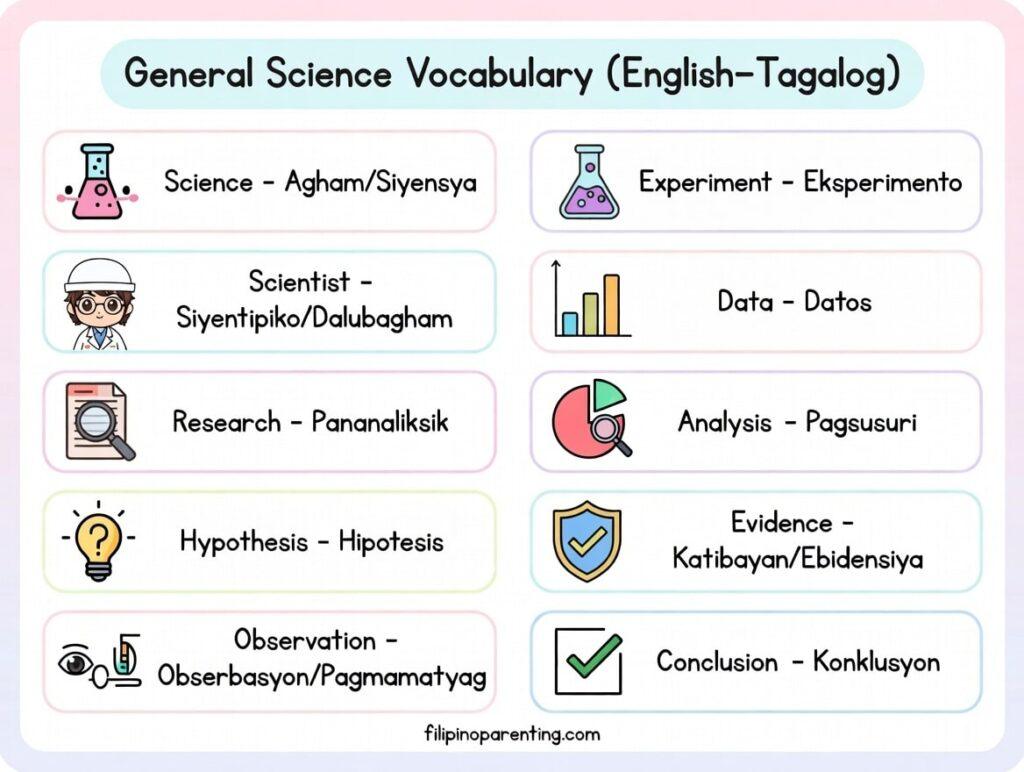
General Science Vocabulary in Tagalog
| English Term | Tagalog Term |
|---|---|
| Science | Agham / Siyensya |
| Scientist | Siyentipiko / Dalubagham |
| Research | Pananaliksik |
| Hypothesis | Hipotesis |
| Observation | Obserbasyon / Pagmamatyag |
| Experiment | Eksperimento |
| Data | Datos |
| Analysis | Pagsusuri |
| Evidence | Katibayan / Ebidensiya |
| Conclusion | Konklusyon |
| Theory | Teorya |
| Method | Paraan |
| Measurement | Pagsukat |
| Result | Bunga / Resulta |
| Variable | Baryabol |
| Model | Modelo |
| Process | Proseso |
| Discovery | Pagkatuklas |
| Knowledge | Kaalaman |
| Investigation | Pagsisiyasat |
Example Phrases
- Research helps us discover new knowledge.
Tumutulong ang pananaliksik sa pagtuklas ng bagong kaalaman. - Scientists study the universe.
Pinag-aaralan ng mga siyentipiko ang uniberso. - Science explains natural events.
Ipinapaliwanag ng agham ang mga likas na pangyayari.
These words form the core vocabulary of scientific thinking in Tagalog, used when asking questions, forming hypotheses, conducting experiments, analyzing data, and explaining results.

2. Life Sciences (Biology-Related | Agham-Buhay)
Life sciences focus on living organisms and the processes that sustain life. These science terms in Tagalog are common in biyolohiya classes, health discussions, and environmental topics.
In science in Tagalog, biology is also called Agham-buhay, literally “the study of life.”
Life Science Vocabulary in Tagalog
| English Term | Tagalog Term |
|---|---|
| Biology | Biyolohiya / Agham-buhay |
| Life | Buhay |
| Cell | Selula |
| Organism | Organismo |
| Tissue | Tisyu |
| Organ | Organo |
| System | Sistema |
| Nucleus | Ubod |
| Growth | Paglaki / Pag-unlad |
| Development | Pag-unlad |
| Reproduction | Reproduksiyon / Pagpaparami |
| Photosynthesis | Potosintesis |
| Respiration | Respirasyon / Paghinga |
| Adaptation | Pag-angkop |
| Evolution | Ebolusyon |
| Species | Uri |
| Population | Populasyon |
| Ecosystem | Ekosistema |
| Plant | Halaman |
| Animal | Hayop |
Life science vocabulary helps learners explain living systems clearly using science in Tagalog, from the human body to ecosystems in nature.

3. Physical Sciences (Chemistry, Physics, and Energy)
Physical sciences explain matter, energy, and forces. These Tagalog science terms appear in pisika and kimika classes and in explanations about motion, electricity, heat, and technology.
Understanding physical science in Tagalog helps learners describe how the physical world works in daily life.

4. Earth and Space Sciences (Agham-Daigdig at Kalawakan)
Earth and space sciences describe the planet, weather, and the universe. These science words in Tagalog are commonly used in geography, meteorology, astronomy, and disaster preparedness.
Using science in Tagalog makes information about weather, earthquakes, and space more accessible and culturally relevant.

How Science Is Used in Tagalog
Science in Tagalog is used in both formal and everyday contexts across education, media, and daily conversation. In academic settings, Tagalog science terms appear in textbooks, exams, research papers, and Filipino-medium instruction.
In everyday life, Filipinos naturally use science vocabulary in Tagalog when talking about weather (panahon), health, the environment, and technology.

Importance and Practical Value of Science in Tagalog
Understanding science in Tagalog provides:
- Clear scientific communication
- Stronger cultural and language identity
- Better academic comprehension
- Practical everyday usage
- Improved scientific literacy
How to Use Science Words in Daily Life
Learning science vocabulary in Tagalog becomes easier when used regularly in simple, practical ways—through reading, watching educational content, and everyday conversations.
Conclusion
Science in Tagalog, known as Agham or Siyensya, plays a vital role in education, communication, and everyday understanding. It connects modern scientific knowledge with Filipino language and culture across biology, chemistry, physics, and earth science.
By learning these science terms in Tagalog, vocabulary lists, explanations, and example phrases—and practicing them regularly—you can confidently discuss scientific ideas in Tagalog while strengthening both language skills and comprehension.