Filipino 5 letter words are the foundation of effective communication for anyone starting their journey with the Tagalog language. Understanding these terms helps beginners and parents bridge the gap between basic greetings and meaningful sentences. Whether you are teaching the younger generation or exploring the culture yourself, focusing on high-frequency Filipino 5 letter words is a smart way to learn.
In this ultimate guide, we will explore 50 essential terms that provide fascinating facts about daily life in the Philippines. By mastering these key Filipino 5 letter words, you can significantly improve your ability to connect with others. These words are short, easy to remember, and appear constantly in both spoken and written Tagalog.
The Importance of Root Words in Tagalog
Language learning is most effective when broken down into manageable pieces. Filipino 5 letter words provide the perfect length for building muscle memory. These words are common enough to be heard in every household but specific enough to carry deep cultural meaning.
Many of these are considered “root words.” In Tagalog, roots are the core part of a word before you add prefixes or suffixes. By learning these 50 everyday gems, you are actually learning the “DNA” of thousands of other Filipino sentences.
Question and Connector Words
These words are the “glue” of the language. They help you ask questions and link ideas together smoothly.
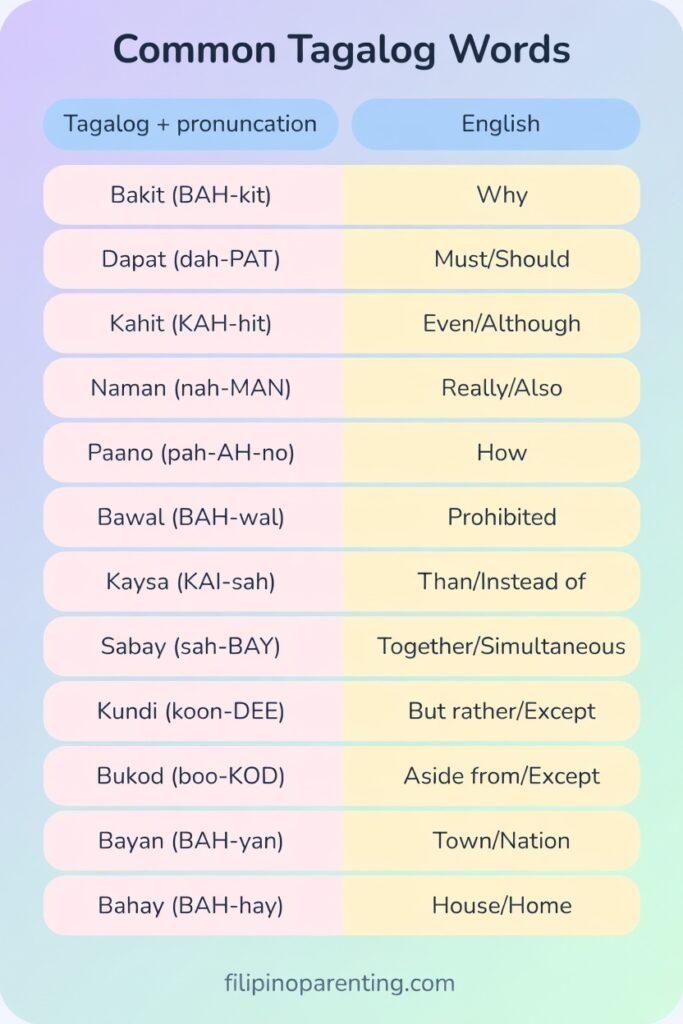
- Bakit (BAH-kit) – Why. “Bakit ka late?” (Why are you late?)
- Dapat (dah-PAT) – Must/Should. “Dapat tayong mag-aral.” (We should study.)
- Kahit (KAH-hit) – Even/Although. “Kahit pagod, masaya ako.” (Even if tired, I am happy.)
- Naman (nah-MAN) – Really/Also. “Ikaw naman!” (Your turn!)
- Paano (pah-AH-no) – How. “Paano ang luto nito?” (How is this cooked?)
- Bawal (BAH-wal) – Prohibited. “Bawal pumasok dito.” (Entry is prohibited here.)
- Kaysa (KAI-sah) – Than/Instead of. “Mas gusto ko ito kaysa iyan.” (I like this more than that.)
- Sabay (sah-BAY) – Together/Simultaneous. “Sabay tayo kumain.” (Let’s eat together.)
- Kundi (koon-DEE) – But rather/Except. “Walang iba kundi ikaw.” (No one but you.)
- Bukod (boo-KOD) – Aside from/Except. “Bukod sa akin, sino pa?” (Aside from me, who else?)
Common Nouns and Objects
Nouns are essential for identifying the people and items in your daily environment.
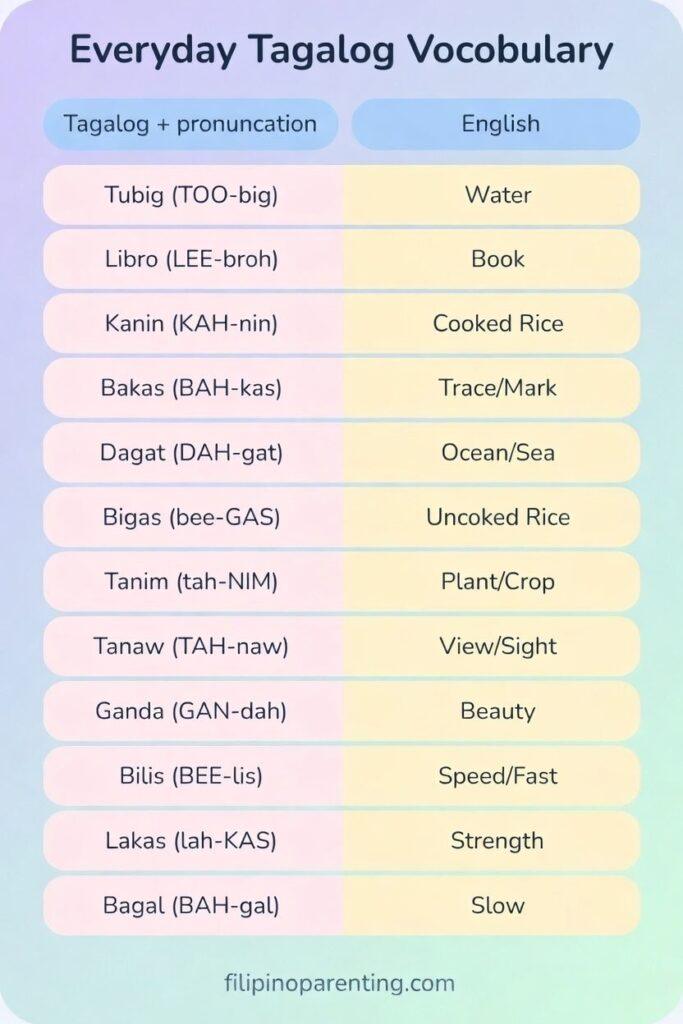
- Bayan (BAH-yan) – Town/Nation. Root of the Filipino saying regarding Bayanihan.
- Bahay (BAH-hay) – House/Home. “Malinis ang bahay.” (The house is clean.)
- Tubig (TOO-big) – Water. “Bigyan mo ako ng tubig.” (Give me some water.)
- Libro (LEE-broh) – Book. “Saan ang libro ko?” (Where is my book?)
- Kanin (KAH-nin) – Cooked Rice. “Mainit ang kanin.” (The rice is hot.)
- Bakas (BAH-kas) – Trace/Mark. “May bakas ng dumi.” (There is a trace of dirt.)
- Dagat (DAH-gat) – Ocean/Sea. “Malalim ang dagat.” (The sea is deep.)
- Bigas (bee-GAS) – Uncooked Rice. “Bumili ka ng bigas.” (Buy some rice.)
- Tanim (tah-NIM) – Plant/Crop. “Tanim na gulay.” (Planted vegetables.)
- Tanaw (TAH-naw) – View/Sight. “Maganda ang tanaw.” (The view is beautiful.)
Adjectives and Descriptions
Use these words to describe the world around you with accuracy and feeling.
- Ganda (GAN-dah) – Beauty. Used in elegant Tagalog words.
- Bilis (BEE-lis) – Speed/Fast. “Ang bilis ng takbo.” (The run is fast.)
- Lakas (lah-KAS) – Strength. Seen in proverbs about inner strength.
- Bagal (BAH-gal) – Slow. “Bakit ang bagal mo?” (Why are you so slow?)
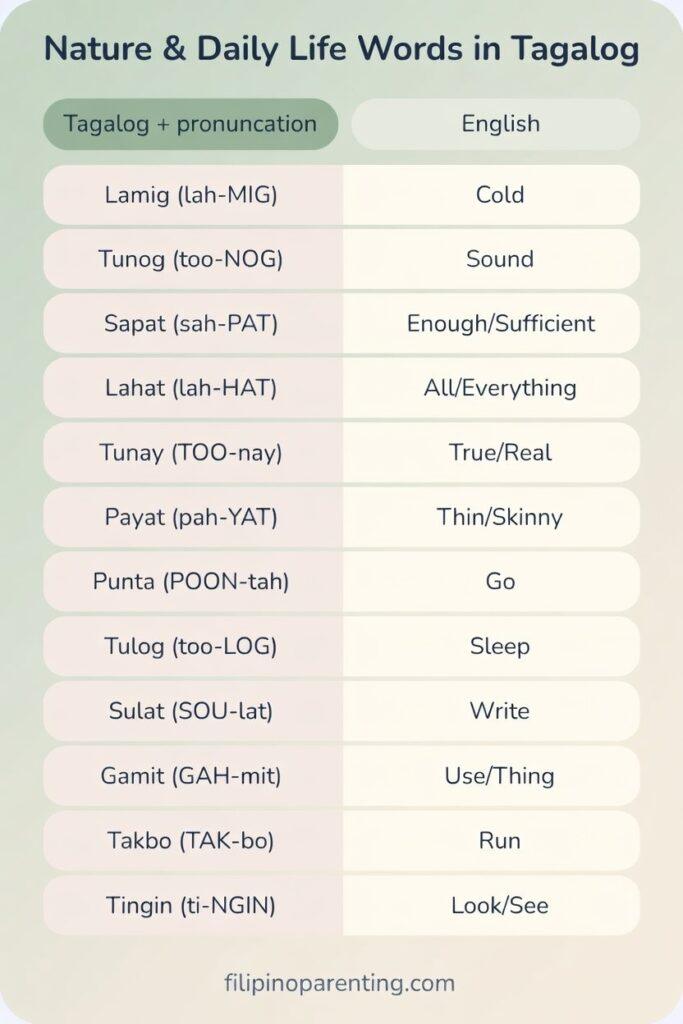
- Lamig (lah-MIG) – Cold. “Ang lamig ng hangin.” (The wind is cold.)
- Tunog (too-NOG) – Sound. “Anong tunog iyon?” (What sound is that?)
- Sapat (sah-PAT) – Enough/Sufficient. “Sapat na ang tulong mo.” (Your help is enough.)
- Lahat (lah-HAT) – All/Everything. “Lahat tayo ay aalis.” (All of us are leaving.)
- Tunay (TOO-nay) – True/Real. “Tunay na kaibigan.” (A true friend.)
- Payat (pah-YAT) – Thin/Skinny. “Payat ang aso.” (The dog is thin.)
Verbs and Actions
Action-oriented words help you describe movement and daily routines.
- Punta (POON-tah) – Go. “Punta tayo sa labas.” (Let’s go outside.)
- Tulog (too-LOG) – Sleep. “Gising na ang tulog.” (The sleeper is awake.)
- Sulat (SOO-lat) – Write. “Sulat ka ng tula.” (Write a poem.)
- Gamit (GAH-mit) – Use/Thing. “Gamit ko ito.” (This is my thing.)
- Takbo (TAK-bo) – Run. “Mabilis ang takbo.” (The run is fast.)
- Tingin (ti-NGIN) – Look/See. “Tingin ka sa akin.” (Look at me.)
- Gulay (GOO-lay) – Vegetable. “Masustansya ang gulay.” (Vegetables are healthy.)
- Dahon (dah-HON) – Leaf. “Berde ang dahon.” (The leaf is green.)
- Bunga (BOO-ngah) – Result/Fruit. “Anong bunga nito?” (What is the result of this?)
- Hiram (hee-RAM) – Borrow. “Hiram ako ng ballpen.” (I will borrow a pen.)
Everyday Essentials
These final words are used constantly in casual and formal settings.
- Bukas (BOO-kas) – Tomorrow. “Magkita tayo bukas.” (Let’s meet tomorrow.)
- Takot (TAH-kot) – Fear. “Walang takot ang bata.” (The learner has no fear.)
- Saksi (sak-SEE) – Witness. “Ikaw ang aking saksi.” (You are my witness.)
- Tatay (TAH-tay) – Father/Dad. Part of Filipino family life.
- Nanay (NAH-nay) – Mother/Mom. “Mabait si Nanay.” (Mom is kind.)
- Lalim (lah-LIM) – Depth. “Ang lalim ng balon.” (The well is deep.)
- Yakap (YAH-kap) – Hug. “Mainit na yakap.” (A warm hug.)
- Langit (LAH-ngit) – Sky/Heaven. “Asul ang langit.” (The sky is blue.)
- Kapit (KAH-pit) – Hold/Grip. “Kapit ka sa akin.” (Hold on to me.)
- Diyan (dee-YAN) – There (near the listener). “Diyan mo ilagay.” (Put it there.)
Deep Meanings in Small Words
Many Filipino 5 letter words carry emotional weight that is hard to translate directly. Take the word Sapat, for instance. It implies a sense of contentment and peace that is central to the Filipino way of life. It reminds us that having “enough” is a blessing when shared with family. This relates deeply to classic Tagalog salawikain that guide character and community.
While these 50 words are a great start, the Tagalog language is rich with variation. For further linguistic study, you can visit the Official Gazette of the Philippines or explore the resources at Tagalog Dictionary.
FAQ about Filipino 5 Letter Words
Are these Filipino 5 letter words suitable for beginners?
Yes, these are high-frequency words that appear in most basic Tagalog sentences.
How can I practice these words at home?
Try using one Tagalog word per sentence when speaking with your family to build comfort.
Why focus on 5 letters?
Five letters often represent the pure root of a word, making them easier to memorize.
Are these words the same as slang?
No, these are standard Tagalog words that are correct in both formal and casual settings.
Do these words have multiple meanings?
Some words, like “Bunga,” can mean both a physical fruit and a result of an action.
Conclusion: Small Words, Big Impact
Mastering Filipino 5 letter words is about more than just memorizing vocabulary; it is about unlocking the heart of our culture. From the kanin on our plates to the yakap we share with the younger generation, these words are the building blocks of a life lived with sincerity and pakikisama. As a Pinay Mom raising a family in Canada, I’ve seen firsthand how these simple terms can turn a regular day into a beautiful opportunity for cultural connection.
Don’t worry about being perfect from the start. Focus on the tunay (true) effort you are making to keep our heritage alive. Every time you use one of these words, you are ensuring that the rhythm of the Philippines continues to beat in your home, no matter where in the world you are.